Reading Time: 13 min read
Lomi vs Mill vs Vitamix FoodCycler: The Quick Verdict
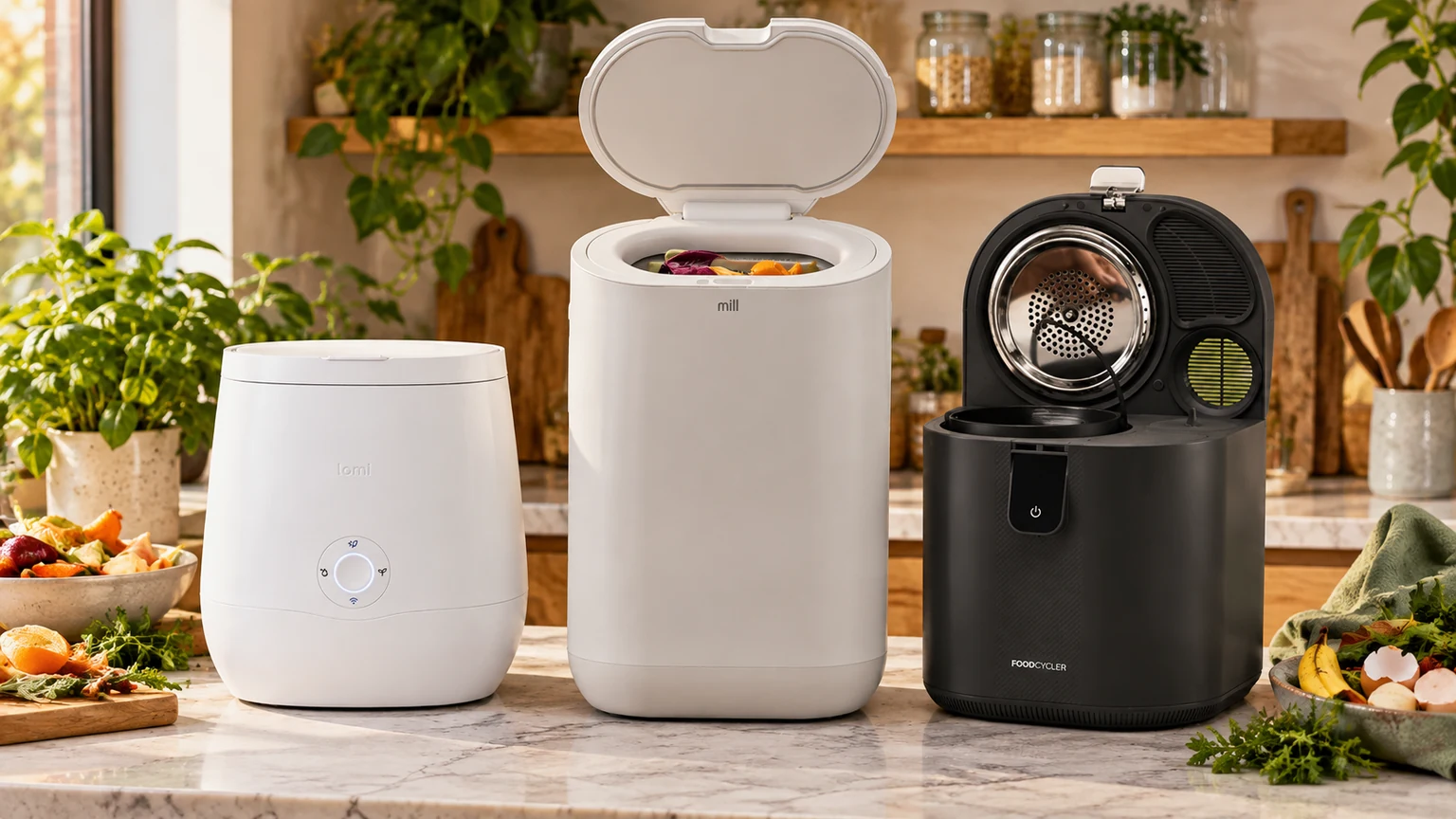
If you live in an apartment and want to keep food scraps out of a smelly trash can, the first thing to understand is that Lomi, Mill and the Vitamix FoodCycler Eco 5 are not three versions of exactly the same appliance. They solve the same kitchen-waste problem in different ways, at very different sizes and price points.
For most apartments, Lomi 3 is our best overall fit. It is the smallest and lightest of the three current options compared here, fits on a normal countertop, offers a fast 3–6 hour Express cycle and gives you a separate longer Grow mode when you want material intended for garden use.
Mill Essential is the best choice for maximum capacity and minimum daily handling, but it is not really a countertop appliance. At 23 inches tall and 45 pounds, it is closer to a smart kitchen bin. Its 6.5-liter chamber, automated operation and ability to keep accumulating dried Food Grounds make it particularly attractive for larger households.
The Vitamix FoodCycler Eco 5 is the strongest straightforward alternative. It has a useful 5-liter bucket, a simple push-button workflow and a refillable carbon filter without requiring the larger floor footprint of Mill.
| Feature | Lomi 3 | Mill Essential | Vitamix FoodCycler Eco 5 |
|---|---|---|---|
| Best for | Most apartments and small kitchens | High-volume households | Simple countertop food recycling |
| Placement | True countertop unit | Floor / kitchen-bin size | Countertop, pantry or garage |
| Capacity | 3 L | 6.5 L | Approx. 5 L |
| Dimensions | 11 × 11 × 12 in | 17 × 14 × 23 in | 13.5 × 10.9 × 13.8 in |
| Weight | 16 lb | 45 lb | Approx. 29–30 lb |
| Processing approach | Heat, grinding, airflow and moisture control | Automatic drying and grinding | Dry, grind and cool cycle |
| Typical cycle | Express: 3–6 h Grow: 11–17 h |
Adaptive automatic cycles, generally runs on schedule | Approx. 4–9 h |
| Odor control | Charcoal filtration | Carbon filtration | Refillable activated-carbon filter |
| Connectivity | Wi-Fi + app | Wi-Fi + app | Simple appliance controls |
| Current US price* | About $549 standalone | $999 | $599.95 |
*Prices are the manufacturers' listed US prices at the time of this 2026 comparison and can change. Check current pricing before purchasing.
First: These Machines Are Food Recyclers, Not Instant Compost Piles
The term countertop composter is convenient for shoppers, but it can create the wrong expectation. Traditional composting is a biological process that takes time. These electric appliances mainly use heat, airflow and mechanical processing to remove moisture and dramatically reduce the volume of kitchen scraps.
Mill is especially explicit about this distinction: its finished Food Grounds are still processed food material rather than finished compost. Lomi describes the output from Lomi 3 as pre-compost. Vitamix describes the Eco 5 as grinding food waste into a fine, dry material that occupies far less space.
That distinction matters if your goal is gardening. Do not assume that whatever comes out of an electric food recycler should automatically be piled directly around plant roots. Follow the manufacturer's directions for using, curing, mixing or otherwise disposing of the processed material.
Lomi 3: Best Overall for Most Apartments
Lomi 3 is the easiest of these three machines to describe as a genuine countertop food recycler. Its 11-by-11-inch footprint and 12-inch height make it significantly easier to accommodate in a small kitchen than Mill, while its 16-pound weight makes it more realistic to reposition when counter space is limited.
The 3-liter bucket is smaller than the chambers in Mill Essential and the Eco 5, but that tradeoff is reasonable for one- or two-person households where physical space matters more than maximum capacity.
What Lomi 3 does well
- Small footprint: 11 × 11 × 12 inches makes it the easiest fit on a normal apartment counter.
- Low published noise level: Lomi specifies operation below 45 dB.
- Two useful processing modes: Express mode runs approximately 3–6 hours, while Grow mode runs approximately 11–17 hours.
- App connectivity: built-in Wi-Fi allows remote cycle control and status information.
- Clear garden-oriented option: the manufacturer distinguishes its longer Grow mode from the faster waste-volume-reduction cycle.
What to consider before buying
The 3-liter chamber is the smallest in this comparison. A household that generates a large amount of food waste may need to run it more frequently than Mill or the Eco 5. The charcoal filtration system is also a consumable: the starter filter supply is rated for roughly 45 cycles, and replacements create an ongoing ownership cost.
Lomi currently lists the standalone Lomi 3 at around $549 in the United States, while a membership package changes the initial price and adds recurring filter deliveries. That makes it important to compare the total ownership model rather than only the headline device price.
Best fit: apartment dwellers, couples, smaller households and anyone who prioritizes counter space and quiet operation.
Mill Essential: Best for Capacity and Minimal Daily Handling
Mill is the outlier in this comparison because the current Mill Essential is substantially larger than a typical countertop appliance. It measures 23 inches high by 17 inches wide by 14 inches deep and weighs about 45 pounds. Think of it as an intelligent food-waste bin rather than something you casually move on and off a counter.
That larger body buys you capacity. Mill Essential has a 6.5-liter chamber, and Mill says the system can keep processing added scraps so that the resulting dry Food Grounds can accumulate for weeks. The company advertises up to roughly four weeks between emptying under suitable use.
What Mill does well
- Largest capacity here: 6.5 liters.
- Continuous workflow: you can add scraps regularly instead of thinking in terms of a small batch every time.
- Automatic operation: sensors and scheduling decide how long the machine needs to run.
- Broad food acceptance: Mill is designed for a wider range of scraps, including some items such as small bones and pits that other machines restrict.
- Strong odor-control focus: activated-carbon filtration is central to the design.
What to consider before buying
The biggest issue for an apartment buyer is physical size. Mill Essential is 23 inches tall; Mill Plus is even taller at 27 inches. Neither is what most people picture when they search for a countertop composter.
Price is also significantly higher. Mill Essential is currently listed at $999, while Mill Plus starts at $1,149. Carbon filters are consumables, and the Essential filter is rated for up to roughly six months depending on use. Mill also offers an optional paid pickup service for households that do not have a use for their Food Grounds.
Best fit: families, serious home cooks and households producing enough scraps to justify a large dedicated kitchen appliance.
Vitamix FoodCycler Eco 5: Best Simple Countertop Alternative
The Vitamix FoodCycler Eco 5 sits between Lomi and Mill physically. Its approximately 5-liter bucket gives it considerably more capacity than Lomi 3, but at 13.5 × 10.9 × 13.8 inches it can still fit on many countertops or in a pantry.
Its operation is straightforward: the machine runs through drying, grinding and cooling stages. Vitamix specifies an approximate processing time of 4–9 hours, depending on the load. The unit uses a refillable activated-carbon filter rather than requiring an entirely disposable filter assembly.
What the Eco 5 does well
- Useful 5-liter capacity: a strong middle ground between Lomi and Mill.
- Simple operation: suitable for users who do not need a highly connected smart appliance.
- Refillable carbon filter: carbon media can be replenished rather than replacing an entire cartridge.
- Compact relative to capacity: it remains feasible for a counter, pantry or utility area.
- Three-year full warranty: longer than many small-appliance warranties.
What to consider before buying
At roughly 29–30 pounds, the Eco 5 is almost twice the weight of Lomi 3. If you need to put the appliance away after every use, that matters. Its bucket is also not dishwasher safe according to Vitamix, so cleaning remains a manual ownership task.
The Eco 5 is currently listed at $599.95 in the United States.
Best fit: users who want more capacity than Lomi without giving up a countertop-compatible footprint, and people who value simple appliance operation over app-heavy automation.
Lomi vs Mill vs FoodCycler: Which Is Best for Apartments?
Best for a studio or very small kitchen: Lomi 3
Lomi wins this category primarily because of physical reality. It is dramatically smaller and lighter than Mill and noticeably easier to move than the FoodCycler Eco 5. For limited counters, cabinets and floor space, those dimensions matter every single day.
Best for a family apartment: Mill Essential — if you have floor space
If several people generate a large volume of scraps, Mill's 6.5-liter capacity and continuously accumulating dry grounds can reduce how often you interact with the machine. But you need a dedicated place for something roughly the size of a narrow kitchen trash can.
Best balance of capacity and simplicity: FoodCycler Eco 5
The Eco 5 provides 5 liters of capacity without the substantial height and weight of Mill. It is not as compact as Lomi, but it is arguably the most conventional appliance of the three.
Odor Control: All Three Are Designed for Indoor Kitchens
Odor management is one of the main reasons to buy an electric food recycler rather than storing wet scraps in a kitchen bin. All three systems use carbon-based filtration.
Lomi uses charcoal filtration, Mill uses replaceable activated-carbon filters, and the Eco 5 uses a refillable activated-carbon system. None of these arrangements is maintenance-free: filters or carbon media eventually need attention.
If odor is your main concern, the important ownership question is therefore not simply does it have a filter? but how often will I need to maintain or replace that filtration system?
Capacity: Mill Wins, But Bigger Is Not Automatically Better
The numbers are straightforward:
- Lomi 3: 3 L
- Vitamix FoodCycler Eco 5: approximately 5 L
- Mill Essential: 6.5 L
A larger chamber is valuable if you cook frequently or have several people in the household. In a studio apartment, however, an extra few liters of capacity may not compensate for giving up substantial floor or counter space.
Speed: Don't Compare These Machines by One Number Alone
The original version of this article claimed that Mill could complete processing in 30 minutes. That is not a reliable way to describe the current Mill system and should not be used as a buying criterion.
Lomi 3 publishes a 3–6 hour Express range and an 11–17 hour Grow range. Vitamix lists approximately 4–9 hours for the Eco 5. Mill uses adaptive scheduled processing and is designed to work automatically, often overnight, rather than around one fixed advertised batch duration.
For apartment use, the more useful question is whether the machine can fit naturally into your routine without forcing you to constantly wait for a bucket to become available.
Cost of Ownership Matters More Than Sticker Price
The appliance price is only the start. Each system has ongoing filtration or accessory considerations.
- Lomi 3: lower device price than Mill, but charcoal filters are recurring consumables.
- Mill: highest initial price in this comparison, with replaceable carbon filters and optional paid Food Grounds pickup.
- FoodCycler Eco 5: refillable carbon filtration helps reduce complete filter-cartridge replacement, although carbon media still needs replenishment.
Before buying, estimate how often your household will actually use the appliance. A machine used once or twice a week has a very different cost profile from one running almost every day.
What We Would Buy for Different Homes
Choose Lomi 3 if:
- You live in a small apartment.
- You need a genuine countertop footprint.
- Low noise is important.
- You want both a quick processing mode and a garden-oriented longer mode.
- A 3-liter chamber is enough for your household.
Choose Mill if:
- Your household generates a lot of food scraps.
- You have dedicated floor space.
- You want to add scraps continuously.
- You prefer automation over manual batch management.
- Higher purchase cost is acceptable.
Choose the FoodCycler Eco 5 if:
- You want more capacity than Lomi.
- You still want a countertop-compatible appliance.
- You prefer straightforward controls.
- A refillable carbon-filter design appeals to you.
- You value Vitamix's three-year warranty.
Skip an electric food recycler if:
- You already have convenient municipal organics collection.
- You have outdoor space and prefer traditional composting.
- You expect finished compost to emerge in a few hours.
- You do not want another powered appliance or recurring filter maintenance.
Final Verdict
Lomi 3 is our pick for the best countertop food recycler for most apartments in 2026. Its combination of a genuinely compact footprint, 16-pound weight, 3-liter chamber, low published noise level and multiple processing modes makes the most sense where kitchen space is limited.
Mill Essential is the better system for volume, not for countertops. If you have room for a dedicated floor-standing appliance and generate a lot of scraps, its 6.5-liter capacity and automated workflow are compelling.
The Vitamix FoodCycler Eco 5 is the middle-ground choice. Its 5-liter capacity is generous, its physical footprint remains manageable and its simple dry-grind-cool workflow avoids some of the complexity of a more connected smart system.
The right choice ultimately depends less on which machine has the most impressive specification and more on three practical questions: how much food waste you generate, how much kitchen space you can surrender, and what you plan to do with the processed material afterward.
FAQ
Which countertop composter is best for a small apartment?
For most small apartments, Lomi 3 has the strongest physical fit. It measures 11 × 11 × 12 inches and weighs about 16 pounds, making it significantly easier to accommodate and move than Mill Essential or the Vitamix FoodCycler Eco 5.
Is Mill actually a countertop composter?
Not really. Mill Essential measures approximately 23 inches high and weighs about 45 pounds. It is better understood as a floor-standing smart food-recycling bin. It belongs in this comparison because apartment shoppers often consider it alongside countertop food recyclers, but its space requirements are very different.
Do Lomi, Mill and FoodCycler create finished compost?
No. These devices should not be confused with a traditional compost pile. Mill explicitly describes its Food Grounds as processed food material rather than finished compost, while Lomi describes Lomi Earth from Lomi 3 as pre-compost. Always follow the manufacturer's instructions before using processed material in soil or around plants.
Which machine has the largest capacity?
Mill Essential has the largest chamber in this comparison at 6.5 liters. The Vitamix FoodCycler Eco 5 is approximately 5 liters, and Lomi 3 is 3 liters.
Which one processes food waste fastest?
Lomi 3 publishes an Express cycle of approximately 3–6 hours. The Vitamix Eco 5 specifies approximately 4–9 hours. Mill does not center its current system around one fixed short batch time; it automatically dries and grinds material on a schedule and is designed to accumulate processed grounds over time.
Which is cheapest to buy?
At the time of this 2026 comparison, Lomi 3 is listed at about $549 standalone, the Vitamix FoodCycler Eco 5 at $599.95, and Mill Essential at $999. Prices and promotions can change, so check current manufacturer pricing before purchasing.
Your Next Step: Choose by Kitchen Constraint, Not Brand Hype
If you are ready to choose, start with the constraint that matters most in your home: available floor or counter space, batch capacity, operating routine and ongoing cost. A small apartment may favor the most compact machine, while a larger household may value capacity more than footprint.
Before buying, compare current manufacturer pricing, filter or subscription requirements and the actual space available in your kitchen. Then use GardHack's zero-waste garden checklist to decide how the processed material fits into the rest of your food-waste system.