Reading Time: 9 min read
Do Self-Watering Planters Really Work for Tomatoes and Peppers?
Yes — when the system is sized correctly and set up with the right potting mix, self-watering planters can make container-grown tomatoes and peppers easier to manage.
The important distinction is that “self-watering” does not mean “never refill.” These planters use a lower reservoir and a wicking or sub-irrigation system to keep moisture available to the root zone. During hot weather or heavy fruiting, large tomato and pepper plants can still empty a reservoir quickly.
For 2026, the best choice depends less on marketing labels and more on four practical questions:
- Is the reservoir large enough for a fruiting crop?
- Is there enough soil volume for the root system?
- Does the planter include or support a sturdy trellis?
- How easy is it to refill, move and monitor?
Quick Comparison: Our 2026 Picks
| Planter | Best For | Key Advantage | Main Limitation |
|---|---|---|---|
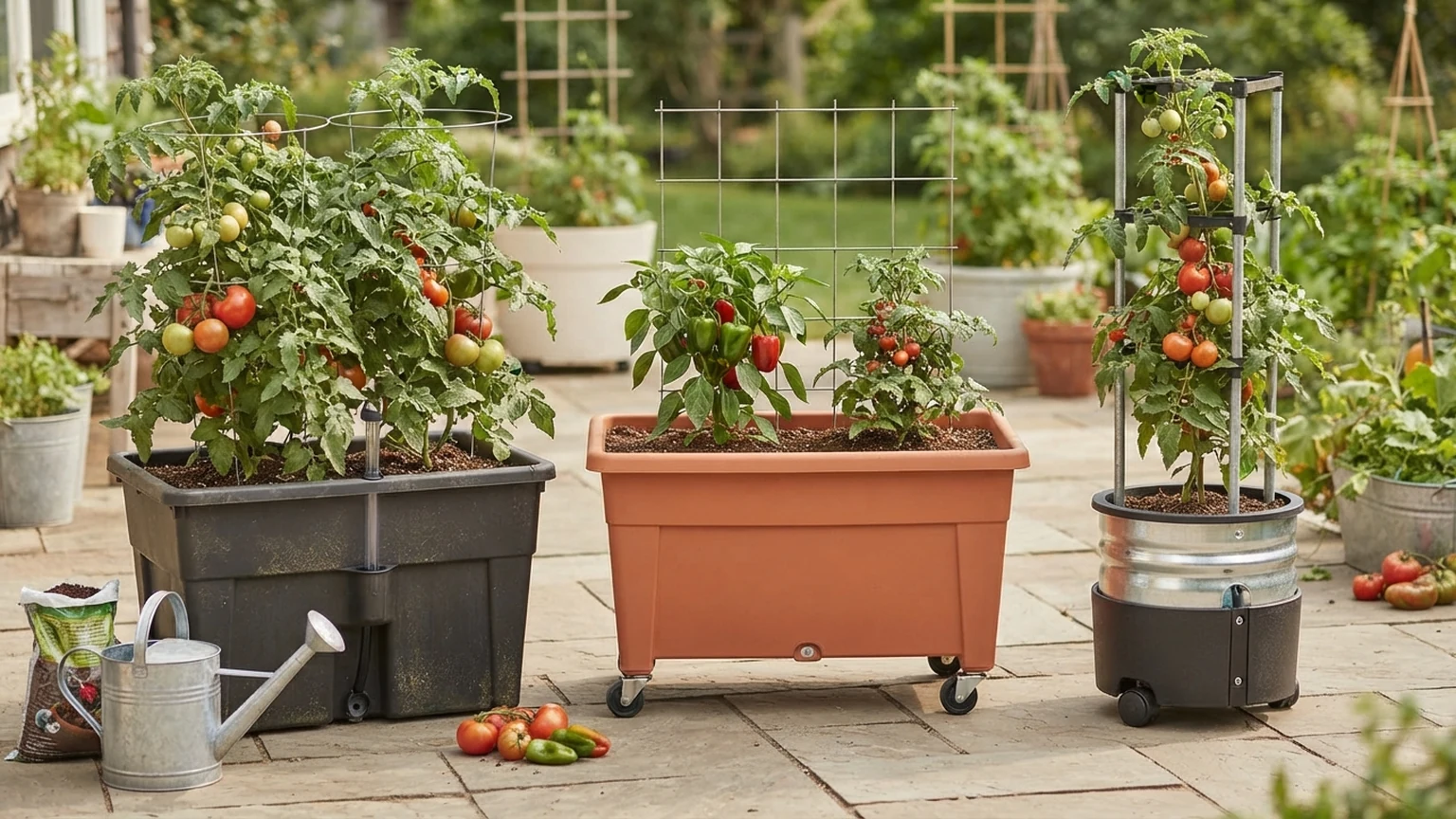
| EarthBox Original / Tomato System | Best overall for tomatoes | Established sub-irrigated design with crop-specific planting guidance | Large plants can still require frequent reservoir refills in hot weather |
| CITY PICKERS Patio Raised Garden Bed | Best budget-value grow box | Large rectangular growing area, self-watering reservoir and casters | Trellis/support is not the main strength of the base planter |
| Vego Garden Self-Watering Rolling Tomato Planter | Best integrated tomato-support system | Compact planter with included multi-tier trellis | Smaller soil volume than wider grow-box systems |
1. EarthBox Original / Tomato Growing System — Best Overall
EarthBox is one of the most established sub-irrigated planter systems available, and tomatoes and peppers are among the crops the company explicitly supports.
The standard EarthBox planter measures about 29 inches long, 13.5 inches wide and 11 inches high. The system uses a lower water reservoir, aeration screen and fill tube to keep moisture available from below.
For tomatoes, EarthBox also sells configurations with a tall staking or trellis system, which is important because a productive tomato plant can quickly become too large for a container without adequate support.
Best for: gardeners who want a proven system and are willing to follow a crop-specific setup method.
Why we like it:
- purpose-built sub-irrigation system,
- tomatoes and peppers are explicitly supported crops,
- large growing box compared with many decorative self-watering pots,
- optional or bundled staking systems for tomatoes,
- mobile configurations are available.
Reality check: the reservoir does not eliminate watering. EarthBox recommends monitoring and refilling regularly; mature fruiting plants in hot conditions may use water rapidly.
2. CITY PICKERS Patio Raised Garden Bed — Best Budget-Value Grow Box
CITY PICKERS offers a rectangular patio grow box that combines a water reservoir, aeration system and casters in a relatively inexpensive package.
The widely sold 24.5 × 20.5-inch version is designed to hold up to about two gallons of water in its reservoir and is marketed specifically for growing tomatoes and vegetables.
The broad rectangular footprint can be useful when you want more growing area than a single-pot design provides.
Best for: budget-conscious patio gardeners who want a proven self-watering grow-box format.
Why we like it:
- relatively low entry price compared with many premium systems,
- integrated reservoir,
- casters for easier repositioning,
- wide growing surface,
- well suited to patios and balconies.
Reality check: tomatoes still need appropriate spacing and support. Do not crowd several large tomato plants into one box just because the surface looks spacious.
3. Vego Garden Self-Watering Rolling Tomato Planter — Best Integrated Trellis
Vego Garden's self-watering rolling tomato planter combines a compact reservoir planter with a multi-tier trellis.
The planter measures about 14.7 × 14.7 inches at the base and holds approximately one cubic foot of soil. The included trellis extends upward to support tomatoes, peppers, cucumbers and other climbing or fruiting crops.
Best for: gardeners who want a compact planter and support structure in one system.
Why we like it:
- integrated trellis,
- rolling planter format,
- compact footprint,
- designed specifically with fruiting vegetables in mind.
Reality check: one cubic foot of soil is less root volume than larger rectangular grow-box systems. Large indeterminate tomatoes may therefore require more careful water and nutrient management.
What Matters More Than Brand
A self-watering planter only works well when the underlying system is appropriate for the crop.
Reservoir Capacity
Tomatoes and peppers use much more water once plants become large and begin producing fruit.
A tiny reservoir may reduce watering frequency early in the season but provide little benefit during peak summer demand.
Soil Volume
Large fruiting plants need enough growing media to support roots, moisture and nutrients.
A small decorative self-watering pot may work well for herbs but still be undersized for a full-season tomato.
Aeration and Overflow
A good sub-irrigated planter does not simply hold water under the soil.
It also needs an aerated root zone and a way for excess water to leave the system. Without those features, permanently saturated growing media can create root problems.
Support for Tomatoes
Tomatoes need physical support as well as water.
For tall or indeterminate varieties, evaluate the trellis or staking system before buying the container. Adding a large support structure later can be awkward once the planter is full and the plant is established.
Tomatoes vs. Peppers: Same Planter, Different Demand
Both crops benefit from consistent moisture, but they do not always place the same demand on the system.
A mature tomato plant can become much larger than a pepper plant and may use reservoir water rapidly during hot weather and fruit production.
Peppers generally fit more comfortably into compact container systems, although they still need adequate root volume, drainage, sunlight and nutrition.
In practice, this means a planter that feels generous for a pepper may be only adequate for a vigorous tomato.
Do You Still Need to Water a Self-Watering Planter?
Yes.
You refill the reservoir rather than watering the soil surface every day, but the reservoir still has to be monitored.
During establishment, some systems also require top watering until roots and the wicking zone are functioning properly.
During hot summer weather, mature fruiting plants may empty a reservoir much faster than expected.
The correct expectation is:
more consistent moisture and fewer watering decisions — not zero watering.
Use the Right Potting Mix
Sub-irrigated systems depend on capillary movement of moisture through the growing medium.
Heavy garden soil can compact and interfere with aeration or wicking.
Follow the planter manufacturer's growing-medium instructions rather than filling the container with ordinary yard soil.
For systems such as EarthBox and CITY PICKERS, proper initial setup of the moist potting mix around the wicking areas is part of what allows the system to function correctly.
How Many Tomato or Pepper Plants Should You Grow?
More plants do not automatically produce more food.
Overcrowding increases competition for water, nutrients and light — exactly the resources that container systems already have in limited supply.
Follow the manufacturer's planting chart where one is provided.
For large tomatoes in particular, conservative spacing is usually safer than trying to maximize the number of plants in one container.
Who Should Buy a Self-Watering Planter?
A self-watering planter makes the most sense when:
- you garden on a patio, balcony or deck,
- containers dry out quickly in your climate,
- you want more consistent root-zone moisture,
- you cannot water several times throughout the day,
- or you want a contained system that can be moved or managed separately.
It may be less useful if you already have a large irrigated raised bed or in-ground garden that meets the same need more economically.
Common Buying Mistakes
Buying by Appearance Instead of Root Volume
A stylish planter can still be too small for a tomato.
Assuming “Self-Watering” Means Maintenance-Free
Reservoirs still need to be checked and refilled.
Ignoring Support
A large tomato plant without a proper cage, stake or trellis can overwhelm an otherwise excellent planter.
Using the Wrong Growing Medium
The wicking system depends on the physical properties of the potting mix.
Overplanting
Too many plants can exhaust both water and nutrients faster than the system can effectively support them.
Our 2026 Verdict
Best overall: EarthBox Original / Tomato System. It offers the most established crop-specific system and is particularly compelling for serious tomato container growing.
Best value: CITY PICKERS Patio Raised Garden Bed. It delivers the core self-watering grow-box concept at a relatively accessible price and provides useful growing area for patios and balconies.
Best integrated support: Vego Garden Self-Watering Rolling Tomato Planter. Its built-in trellis makes it particularly convenient when vertical plant support matters.
No single planter is automatically best for every tomato or pepper plant. Reservoir size, root volume, support, climate and plant variety matter more than the label on the container.
FAQ
Do self-watering planters really work?
Yes. Properly designed sub-irrigated planters use a reservoir and wicking system to provide more consistent moisture from below. They still require monitoring and refilling.
Are self-watering planters good for tomatoes?
They can be very effective for tomatoes when the planter provides enough soil volume, reservoir capacity and physical support for the variety being grown.
Are they good for peppers?
Yes. Peppers generally fit well into self-watering container systems, provided they receive adequate sunlight, nutrients and root space.
Can a self-watering planter overwater plants?
A properly designed system uses an overflow point and aerated growing zone to prevent the entire root area from remaining submerged. Problems are more likely when the system is assembled incorrectly or filled with unsuitable growing media.
How often do I refill the reservoir?
It depends on planter size, weather, crop and plant maturity. Young plants may use relatively little water, while mature tomatoes in hot weather may require very frequent refilling.
What is the most important feature for tomatoes?
Do not focus on the reservoir alone. Tomatoes need sufficient root volume and strong support as well as consistent moisture.
Your Next Step: Match the Planter to the Crop
For tomatoes, prioritize root volume, reservoir capacity and strong physical support. For peppers, adequate root space and reliable moisture remain important, but the support structure may be simpler.
Do not buy on reservoir size alone. Compare the complete growing volume, overflow design, support options and refill access. If your main problem is watering consistency rather than planter choice, continue with GardHack's water-smart balcony garden guide.