Reading Time: 8 min read
How to Think About a $500 Harvest Target
Can a 40-square-foot vegetable garden replace $500 worth of grocery-store produce in one season?
It can be a realistic stretch target in the right climate and crop mix, but it is not a guaranteed outcome.
The result depends on what you grow, how long your season lasts, local grocery prices, how intensively the space is planted, how much of the harvest your household actually uses, and whether the same square foot produces more than one crop during the season.
The important idea is not to chase a fixed dollar number. It is to design the 40 square feet so that the space produces as much usable grocery replacement as practical.
The Core 40-Square-Foot Strategy
A small garden becomes much more productive when you combine three techniques:
- vertical growing for crops such as tomatoes, cucumbers and pole beans,
- succession planting so the same soil produces more than one crop during the season,
- high-value crop selection rather than filling most of the bed with bulky low-value staples.
Penn State Extension describes square-foot-style beds as a way to organize intensive planting in one-foot grids and specifically notes that sprawling crops such as cucumbers, beans and tomatoes can be trained vertically to make better use of limited garden space.
A Practical 40-Square-Foot Layout
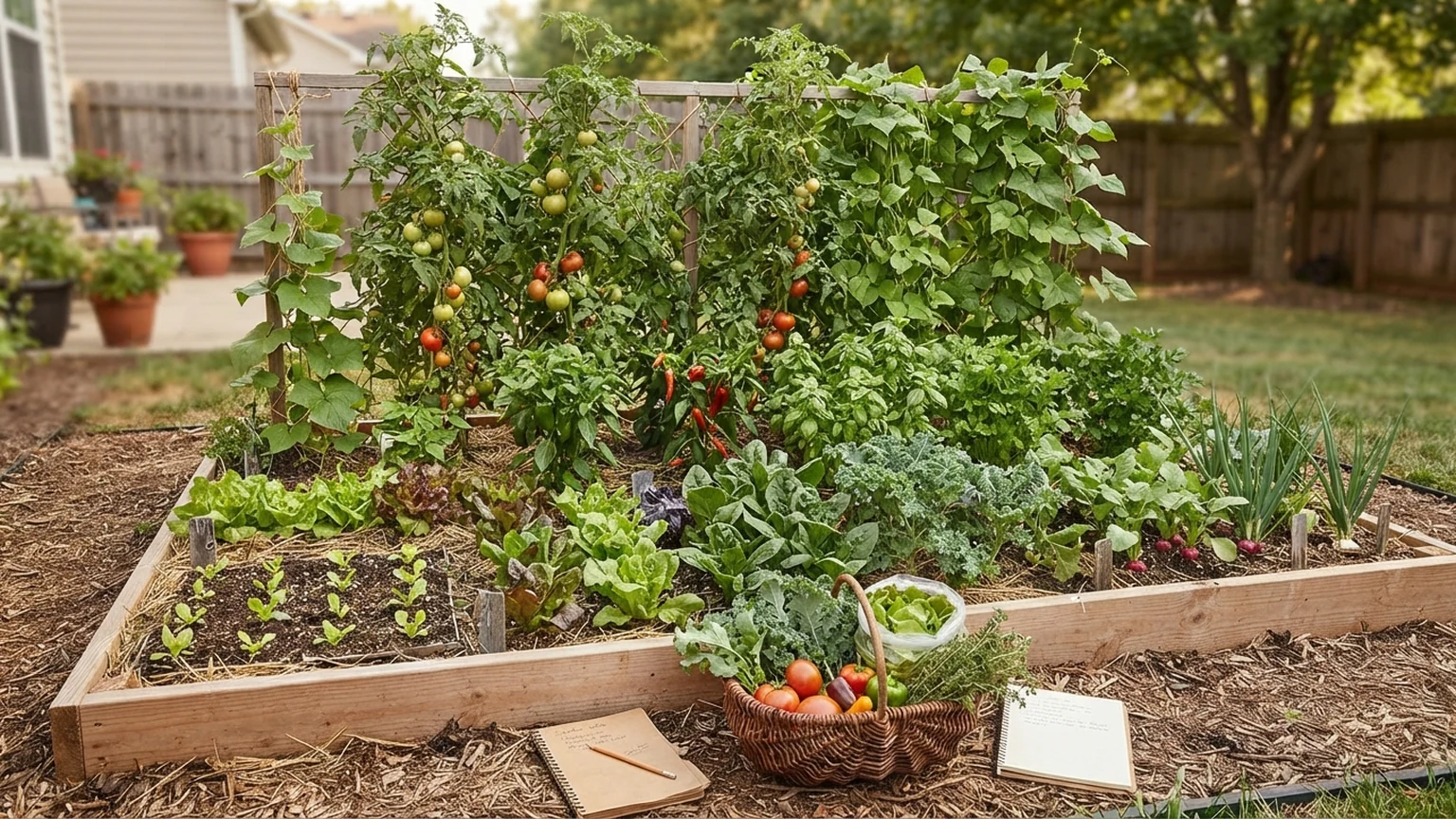
Think of the garden as a 4 × 10-foot bed or another shape providing roughly 40 square feet of growing area.
Instead of giving every crop equal space, divide it according to how efficiently each crop can replace food you already buy.
| Garden Zone | Approx. Space | Crop Role |
|---|---|---|
| Vertical fruiting zone | 12 sq ft | Tomatoes, cucumbers or pole beans trained upward |
| Leafy-green zone | 10 sq ft | Lettuce, spinach, kale, arugula or similar repeat/succession crops |
| Peppers + herbs | 8 sq ft | Compact peppers plus frequently used culinary herbs |
| Fast-turnover zone | 6 sq ft | Radishes, greens, scallions or other short-season crops |
| Flexible succession space | 4 sq ft | Second or third crop after an earlier harvest |
This is a planning model, not a universal planting chart. Your climate, varieties and mature plant spacing should determine the final layout.
1. Use the North or Back Edge for Vertical Crops
Tall crops should usually be positioned where they will not shade the rest of the bed unnecessarily.
Tomatoes, cucumbers and pole beans can make far better use of a small footprint when they are supported vertically.
Tomatoes in particular need enough spacing and sturdy support. Penn State recommends substantial spacing and support for full-size tomato plants rather than crowding multiple mature plants into a tiny area.
The point is not to squeeze in the maximum number of tomato plants.
The point is to give a smaller number of productive plants enough light, root space and airflow to perform well.
2. Prioritize Crops with Strong Grocery-Replacement Potential
Not every pound of harvest has the same economic value.
University of Minnesota Extension's crop-planning data classifies crops such as kale, collards, arugula, mustard greens, leaf lettuce, spinach, garlic and tomatoes among relatively higher-value vegetables, although labor requirements vary.
For a home garden, this suggests a useful principle:
Use scarce space for crops that are expensive enough to buy, productive enough to justify the space, and foods your household already consumes.
Strong candidates include:
- leaf lettuce, spinach and kale,
- fresh herbs,
- tomatoes,
- peppers,
- pole beans,
- cucumbers where vertical support is practical.
3. Make the Same Square Foot Produce More Than Once
This is where the economics of a small garden improve dramatically.
Succession planting means replacing one harvested crop with another rather than leaving the soil unused for the rest of the season.
Penn State and Utah State Extension both describe succession planting as a practical way to extend harvests and increase production from limited garden space.
A possible sequence might be:
- spring spinach or lettuce,
- followed by beans or another warm-season crop,
- followed by fall greens where the local season permits.
The exact sequence depends on frost dates and climate.
4. Grow Up, Not Just Out
A 40-square-foot garden has a fixed ground footprint, but the usable growing volume can increase when climbing crops are trained vertically.
Good candidates include:
- indeterminate tomatoes,
- pole beans,
- trellised cucumbers.
Use sturdy supports installed early rather than trying to add a trellis after plants are already large.
5. Keep Fast Crops Moving Through the Bed
Short-season greens and radishes can occupy space before or after long-season crops.
This matters because a bed that produces only one crop per year leaves a large part of its potential unused.
University of Minnesota Extension specifically identifies leafy greens such as spinach, arugula and leaf lettuce as short-season crops that can fit into early spring and fall production windows.
6. Track Harvest Value, Not Just Pounds
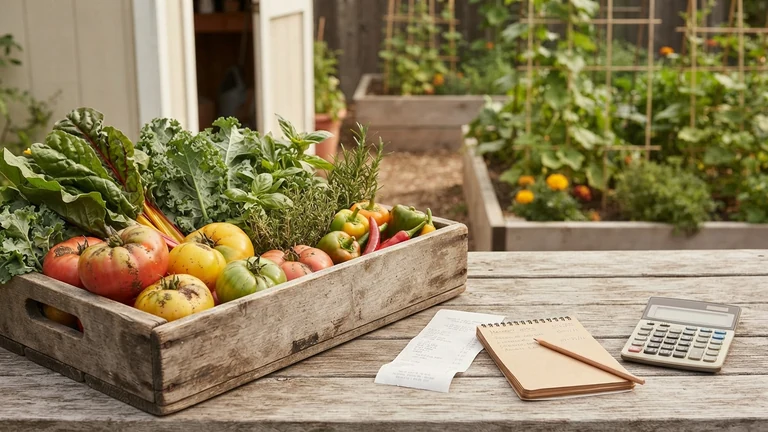
The "$500" number only means something if the harvest replaces real purchases.
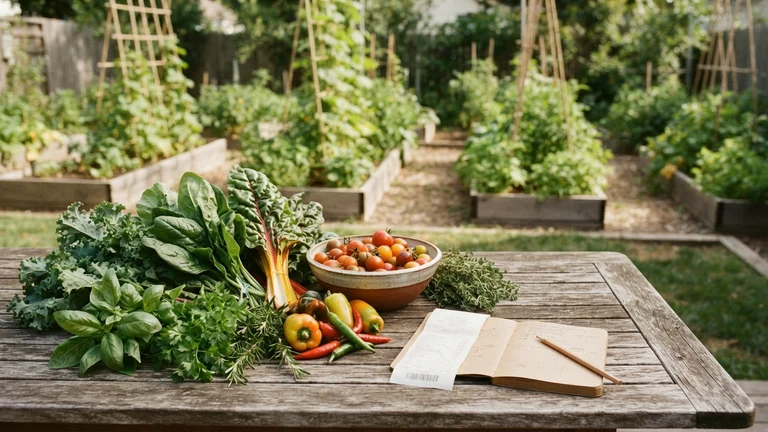
For every crop, record:
- how much you actually harvested,
- how much your household used,
- what equivalent produce costs at your normal grocery store,
- and what you spent to grow it.
A simple formula is:
Usable harvest value − growing costs = potential grocery offset.
If you grow 20 pounds of something your family does not eat, its practical grocery-replacement value is close to zero.
What Would a $500 Season Require?
Think of $500 as a seasonal target composed of many smaller harvests rather than one spectacular crop.
For example, the garden might generate value through a combination of:
- repeated leafy-green harvests,
- fresh herbs harvested throughout the season,
- several productive tomato plants,
- peppers harvested over many weeks,
- vertical beans or cucumbers,
- and replacement crops planted after early harvests finish.
The exact dollar value cannot be predicted responsibly without local prices and real harvest data.
What can be controlled is the system:
high-value crops + vertical growing + succession planting + low waste.
Avoid the Biggest 40-Square-Foot Mistake: Overcrowding
Intensive gardening does not mean ignoring mature plant size.
Tomatoes require substantial space, light and airflow. Tall crops can shade smaller crops. Root systems compete for moisture and nutrients.
Utah State Extension specifically recommends considering the shading effects of tall plants and using vertical supports strategically rather than simply packing plants together.
Give each crop enough room to perform before trying to fill every visible gap.
Do Not Assume Every Bush Bean Grows Six Feet Tall
The original version of this article incorrectly suggested that some bush beans can reach six feet.
That confuses bush types with climbing or pole beans.
If you want vertical production, choose a pole bean variety and provide a trellis. If you want a compact unsupported planting, choose bush beans.
Sunlight Still Sets the Ceiling
Intensive layouts cannot compensate for inadequate light.
Tomatoes generally require at least six hours of direct sun daily, and productive fruiting crops typically perform better with strong sun exposure.
If part of the bed receives less light, reserve that area for crops that tolerate somewhat lower light rather than forcing tomatoes into it.
Keep Infrastructure Efficient Too
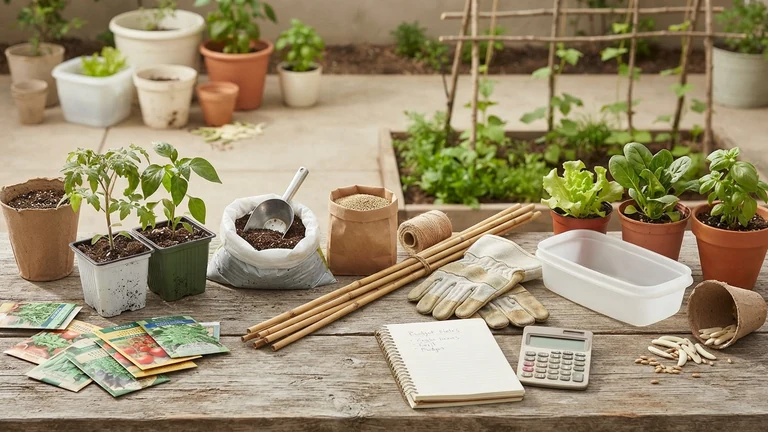
A high-value garden can still have poor ROI if the first season requires expensive raised-bed materials, premium irrigation hardware and unnecessary accessories.
Reuse trellises and supports for multiple seasons. Use mulch where appropriate to moderate soil moisture. Build the garden so that its infrastructure continues producing value next year.
Example Seasonal Sequence
A compact garden might operate like this:
Early Season
- spinach,
- leaf lettuce,
- radishes,
- cilantro or parsley.
Main Summer Season
- trellised tomatoes,
- peppers,
- pole beans,
- trellised cucumbers,
- basil.
Late Season
- another sowing of lettuce,
- spinach,
- kale,
- radishes where temperatures allow.
The exact calendar must follow your local frost dates and temperatures.
Reality Check: $500 Is a Target, Not a Promise
A 40-square-foot garden may produce more or less than $500 in grocery-equivalent value.
Results change with:
- local food prices,
- climate,
- season length,
- variety choice,
- pest and disease pressure,
- watering and soil fertility,
- gardening skill,
- and how much of the harvest is actually eaten.
The strongest claim we can responsibly make is this:
Forty square feet can produce a surprising amount of useful food when high-value crops, vertical supports and succession planting are managed deliberately.
The Bottom Line
Do not build a 40-square-foot garden around a promise that it will automatically produce $500 worth of vegetables.
Build it around a system:
- grow food you already buy,
- prioritize high-value and repeat-harvest crops,
- train suitable crops vertically,
- use succession planting,
- avoid overcrowding,
- track real harvest value.
If those pieces work well together, a $500 grocery-offset season can become a meaningful target rather than an unsupported marketing claim.
FAQ
Can 40 square feet really produce $500 worth of vegetables?
It is possible under favorable conditions, but it is not guaranteed. Local produce prices, crop selection, climate, yield and how efficiently the bed is replanted all affect the result.
What crops provide the best value in a small garden?
Leafy greens, herbs, tomatoes, peppers and some vertically grown crops can be strong candidates because they combine useful grocery value with efficient use of space. The best crops are still the ones your household actually eats.
Should I use square-foot gardening spacing?
A one-foot grid is useful for organizing an intensive bed, but mature crop size still matters. Large plants such as tomatoes need substantially more space than lettuce, radishes or herbs.
How do I get more than one harvest from the same space?
Use succession planting. Grow a short-season crop, harvest it, and replace it with another crop suited to the next part of your growing season.
Should tomatoes be grown vertically?
Vertical support is especially useful in limited space, but plants still require adequate spacing, root volume, sunlight and airflow.
How should I calculate the value of my harvest?
Record the amount your household actually uses, compare it with the price of equivalent produce you would normally buy, and subtract your growing costs.