Reading Time: 11 min read
A 4×6-foot balcony gives you only 24 square feet of floor area, but that does not mean you are limited to 24 square feet of productive growing surface. Containers, shelving and trellises can expand the usable planting area vertically.
That still does not make a specific harvest weight automatic.
The “40 pounds” in this layout should be treated as an illustrative high-output planning scenario — not a guaranteed or measured yield. Actual production depends on crop varieties, sunlight, container volume, weather, growing season, fertility, irrigation, pest pressure and how effectively each planting position performs.
What the “40 Pounds” Figure Actually Means
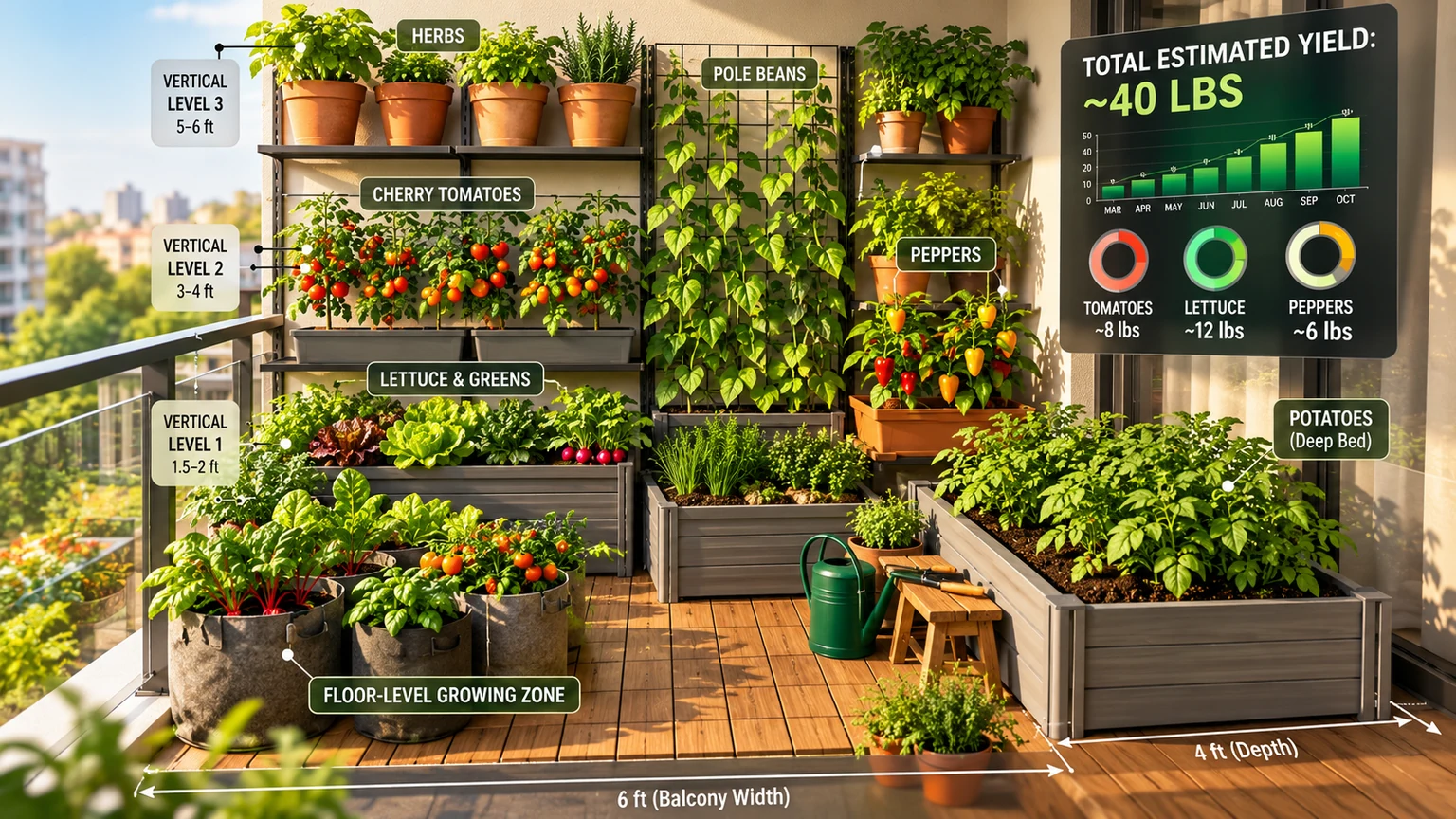
The layout shown for this article is a planning model designed to demonstrate how a very small balcony could combine several productive growing zones.
Any labels such as “~40 lbs total,” “+8 lbs,” or “+12 lbs” shown in concept visuals are illustrative planning estimates. They are not promises that a gardener using the same footprint will harvest those exact quantities.
Yield can vary substantially even between two balconies with the same dimensions.
The more useful question is:
How can a 4×6 balcony be arranged so that every safe, well-lit growing position performs a useful job?
The 4×6 Footprint: What Fits Before Plants Go In
Twenty-four square feet is small enough that circulation space matters almost as much as planting space.
Before placing containers, identify:
- the door swing and emergency access route,
- the usable walking path,
- areas receiving the strongest sunlight,
- areas shaded by walls or railings,
- wind exposure,
- drainage direction,
- and the locations where vertical structures can be secured safely.
A layout that fills every inch with containers but makes the balcony difficult to enter, water or maintain is not an efficient layout.
Vertical Level 1: Low Crops and Floor-Level Containers
The lowest productive layer is usually best for crops that remain compact or tolerate some partial shading from taller plants.
Depending on exposure, examples can include:
- leaf lettuce,
- spinach during suitable temperatures,
- radishes,
- compact herbs,
- and low-growing succession crops.
Floor-level containers should still receive adequate light and airflow. A shelf above them can easily create more shade than expected.
Vertical Level 2: Productive Mid-Height Containers
The middle layer can carry crops that need more root volume and stronger light without requiring the entire height of the balcony.
Possible examples include:
- compact peppers,
- determinate or compact tomatoes,
- larger leafy-green containers,
- and selected bush-type crops.
The exact container size matters more than the visual height of the shelf. A productive plant needs enough root volume, not simply an elevated position.
Vertical Level 3: Herbs and Lightweight Containers
Upper shelves can work well for relatively lightweight pots containing herbs or shallow-rooted crops.
Useful candidates may include:
- thyme,
- chives,
- parsley,
- basil where light and temperature suit it,
- and microgreens in appropriate conditions.
Upper shelves should not become a storage zone for heavy wet containers unless the structure and balcony are designed to support them safely.
Trellis Space Is Different From Shelf Space
True climbing crops such as pole beans and peas can use a vertical trellis efficiently because their growth habit naturally follows supports.
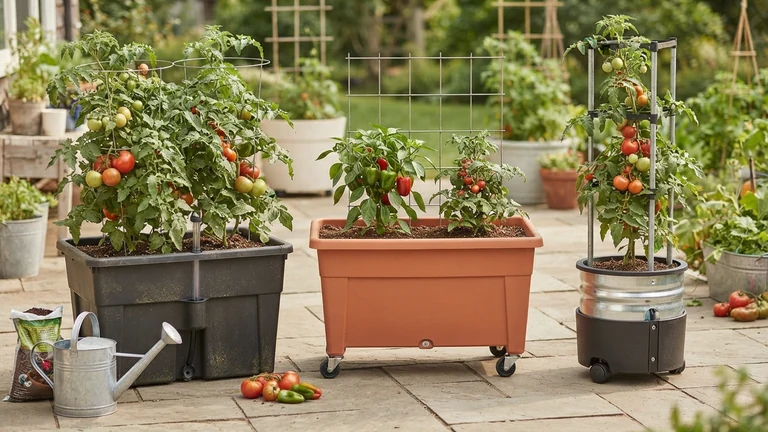
Tomatoes are different. They do not climb a trellis in the same way beans do. Indeterminate tomatoes can be trained and tied vertically, while determinate or bush tomatoes may need cages or other support.
That distinction matters because a vertical layout should match the plant's actual growth habit rather than treating every tall crop as a climber.
Floor Beds vs Wall-Mounted Containers
Floor-level raised containers offer more root volume but consume valuable walking area.
Wall-mounted or shelf-supported containers preserve floor space but introduce other constraints:
- lower soil volume,
- faster drying,
- greater structural loading on shelves,
- more wind exposure,
- and possible shading of crops below.
A balanced 4×6 design usually uses both rather than trying to move every crop onto the wall.
Crop Selection Should Be Based on Space Efficiency
High-output small-space gardening is less about growing the largest possible vegetable and more about using each position for a crop that fits it well.
Useful characteristics include:
- compact growth,
- short or repeatable harvest cycles,
- high edible yield relative to container size,
- vertical growth where appropriate,
- and compatibility with succession planting.
This is why herbs, leafy greens, radishes, peppers, compact tomatoes and climbing beans often make more sense than extremely sprawling crops.
Why Leafy Greens, Herbs and Radishes Fit the Model
Leafy greens and herbs can provide repeated harvests from relatively small containers when temperature and light conditions are suitable.
Radishes can also fit into short-season rotations, but maturity time varies by cultivar, temperature and growing conditions. A fixed claim such as “ready in 20 days” should not be treated as universal.
These crops are useful in a high-output layout because they can occupy smaller gaps and shorter seasonal windows than many large-fruited vegetables.
Where Tomatoes, Peppers and Beans Fit
Fruiting crops can contribute a large share of the seasonal harvest, but they also demand more root volume, light, nutrients and water.
A compact balcony may support:
- one or two well-sized tomato containers,
- several compact pepper plants,
- and a narrow trellis of pole beans.
Trying to maximize plant count by shrinking every container usually works against the goal of maximizing useful production.
Why Potatoes Need More Depth Than Vertical Display Space
Potatoes are sometimes included in compact-garden plans because they can grow in bags or deep containers.
But they need meaningful root and tuber volume.
They are therefore better treated as a deep-container crop than as a vertical-shelf crop.
A potato grow bag may fit physically on a balcony while still being a poor choice if it blocks circulation or adds too much saturated weight.
Large Sprawling Crops Can Be Expensive in Square Feet
Zucchini and other large squash can produce well, but they can occupy a disproportionate amount of balcony space.
On a 4×6 footprint, they are not automatically the best choice for a high-output design.
If included at all, select genuinely compact varieties and account for the mature leaf spread before allocating the space.
Succession Planting Without Overcrowding
Succession planting can increase the number of harvest opportunities from the same container, but there is no universal requirement to sow every one or two weeks.
The interval depends on:
- crop maturity,
- temperature,
- season length,
- available container space,
- and how quickly the previous crop is harvested.
A better method is to plant the next batch when there is a realistic future opening in the layout.
Succession planting should create continuity — not permanent overcrowding.
Sunlight and Self-Shading
A vertical garden can increase planting area while simultaneously reducing light to the layers below.
Before installing three levels of shelving, observe how sunlight moves across the balcony.
Place the tallest plants where they are least likely to shade crops that require stronger light.
Remember that the sun angle changes during the season, so a layout that works in May may shade differently in August.
Balcony Load Capacity Comes Before Yield
Soil, containers and stored water become heavy.
A productive garden can therefore create a substantial concentrated load, especially after irrigation.
Before adding deep beds, large reservoirs or multiple tiers of wet containers:
- check building rules,
- respect any known balcony load limits,
- avoid concentrating unnecessary weight in one area,
- and obtain qualified building guidance when structural capacity is uncertain.
No yield target is more important than structural safety.
Wind Exposure and Trellis Safety
Balconies above ground level can experience stronger and more turbulent wind than gardens at street level.
Trellises, tall tomato supports and vertical frames can act like sails.
Secure structures appropriately and avoid relying on lightweight freestanding frames for tall crops in exposed locations.
Plants can also lose water faster under persistent wind, increasing container irrigation demand.
Drainage and Neighbor Runoff
A high-output balcony garden can require many containers, which means drainage must be planned as carefully as irrigation.
Check:
- where excess irrigation water travels,
- whether saucers can overflow,
- whether the floor drain remains accessible,
- and whether runoff could reach neighboring balconies or building surfaces.
More containers should not mean more uncontrolled runoff.
Access Is Productive Space Too
It can be tempting to treat every empty square inch as a place for another pot.
That can reduce productivity if you can no longer reach plants for pruning, harvesting, pest inspection or irrigation maintenance.
Keep a usable central access path and make sure every container can be reached without repeatedly moving several others.
Watering Becomes Harder as Plant Density Increases
High-density layouts have different water demands across different container sizes and crops.
A practical system groups plants by water need where possible and avoids assuming that every container should receive the same amount.
Drip irrigation, self-watering containers or careful hand watering can all work, but the layout should make inspection easy.
A Realistic Yield Depends on Conditions
A 4×6 balcony does not have one predictable harvest weight.
Results depend on:
- hours and intensity of sunlight,
- length of growing season,
- crop and cultivar selection,
- container volume,
- fertility,
- pollination,
- temperature,
- wind,
- water management,
- pest and disease pressure,
- and how many successive crops actually mature.
A well-designed balcony can produce a meaningful amount of food. That is different from guaranteeing a specific number of pounds.
How to Read the Yield Labels in the Layout Visuals
The yield graphics accompanying this concept are intended to show how a planning model can distribute production across several crop zones.
They should be read as illustrative scenario values, not as experimental results.
For example, visual labels such as:
- “~40 lbs total estimated yield,”
- “+8 lbs,”
- “+12 lbs,”
- or crop-specific pound values
do not represent guaranteed output from every plant or container.
The visuals explain the spatial concept. Your actual harvest is determined by the biological and environmental conditions of your balcony.
What This Layout Cannot Guarantee
This layout cannot guarantee:
- 40 pounds of produce,
- a fixed yield from tomatoes or peppers,
- specific harvest dates,
- successful production on a shaded balcony,
- adequate structural capacity,
- or identical performance in every climate.
Think of it as a layout framework that can be adapted — not a production contract.
A Practical 4×6 Balcony Workflow
- Measure the true usable footprint.
- Keep the door and access path clear.
- Observe sunlight throughout the day.
- Check building and load constraints.
- Identify the safest locations for vertical supports.
- Reserve deep containers for crops that need root volume.
- Use shelves for lighter and more compact crops.
- Group crops by light and water requirements.
- Plan drainage before increasing plant count.
- Add succession crops only when space becomes available.
- Track actual harvests instead of relying on estimated labels.
- Adjust next season's layout from the results you measured.
The Bottom Line
A 4×6 balcony can support much more food production than its 24-square-foot floor area initially suggests because vertical growing, succession planting and carefully selected containers expand the productive surface.
But the objective should not be to force the balcony to hit an arbitrary weight target.
The better goal is to build a layout that safely uses available light, root volume, vertical space and growing time while remaining accessible and manageable.
Forty pounds can be treated as an ambitious planning scenario. The real success metric is how efficiently and safely your specific balcony converts limited space into useful harvests.
FAQ
Can a 4×6 balcony really grow 40 pounds of vegetables?
It is possible for a productive small-space garden to accumulate substantial harvest weight across a season, but 40 pounds should not be treated as a guaranteed result. Actual production depends on crop mix, climate, sunlight, container size, season length and management.
Does vertical gardening increase yield?
Vertical growing can increase usable planting area, particularly for crops suited to trellises or shelves. It does not automatically increase biological yield if lower plants become shaded or containers are too small.
Should I plant every one or two weeks?
Not automatically. Succession intervals should follow crop maturity, seasonal conditions and when space will actually become available.
Are tomatoes climbing plants?
Not in the same way as pole beans or peas. Indeterminate tomatoes can be trained vertically and tied to supports, while compact or determinate tomatoes are usually supported rather than allowed to climb naturally.
Are potatoes efficient on a small balcony?
They can work in deep bags or containers, but their root-volume and weight requirements mean they should be evaluated against other possible uses of limited floor space.
What should I check before installing several vertical levels?
Check sunlight, self-shading, wind exposure, structural support, balcony load constraints, drainage and whether you can safely reach every level for maintenance.
How should I use the yield figures shown in the layout images?
Treat them as illustrative planning estimates used to explain the layout concept. They are not measured harvest results or guarantees.
Build a More Resilient Garden
One practical system every Tuesday — water-smart gardening, food resilience, permaculture and small-space growing.
No fluff. No spam. Just practical systems that work.