Reading Time: 10 min read
By Gardhack Editorial
4 min read
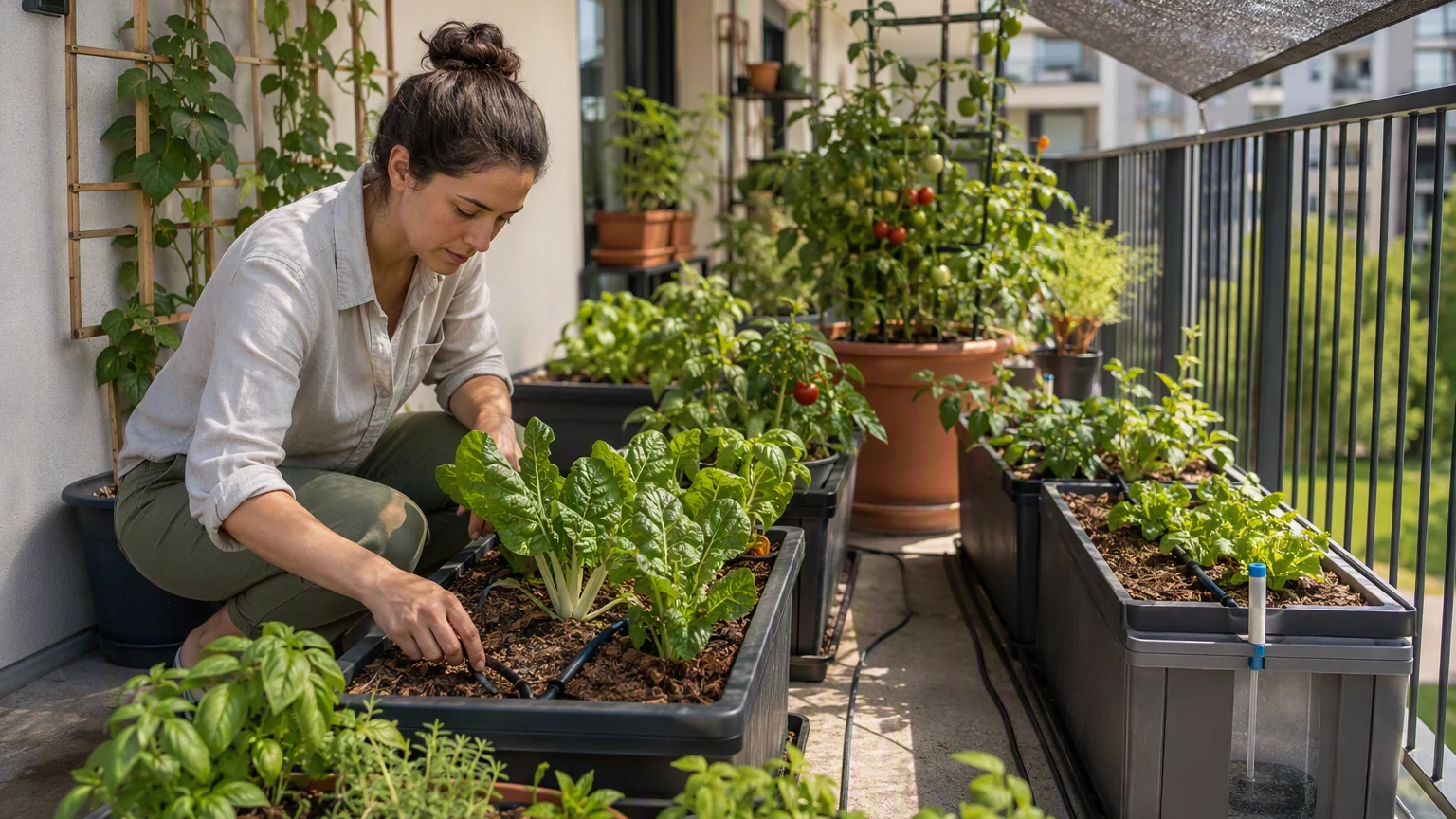
A water-smart balcony garden is not a garden that barely needs water. It is a container garden designed so that the water you apply reaches the root zone, stays available long enough to be useful and does not disappear unnecessarily through evaporation, leaks or uncontrolled runoff.
That distinction matters because balcony containers can dry much faster than in-ground beds. Heat reflected from walls, wind exposure, small root volumes and porous pots can all increase watering demand.
The goal is not “minimum watering.” The goal is deliberate watering.
Start With the Balcony Before You Buy Plants
Before choosing containers or irrigation equipment, observe the balcony itself.
Map:
- direct-sun hours,
- afternoon heat,
- wind exposure,
- areas shaded by walls or railings,
- where excess water can drain,
- where containers can sit without blocking access,
- and where irrigation tubing can run safely.
A balcony facing west may experience intense afternoon heat. A balcony several floors above street level may experience significant wind. A recessed balcony may receive much less rainfall than nearby outdoor spaces.
Your watering strategy begins with those conditions.
Choose Container Size Before Choosing Container Style
Small containers have less growing medium and therefore less stored moisture available to plant roots.
Larger containers usually provide a more stable root environment and tend to dry more slowly than tiny pots.
For water-smart growing, prioritize adequate root volume over squeezing the maximum possible number of pots onto the balcony.
A large tomato plant in an undersized container can require frequent watering even if the irrigation system itself is efficient.
Container Material Changes Water Loss
Container material also matters.
Unglazed terracotta and some wood containers are porous and can lose moisture through their sides. Plastic, fiberglass, metal and glazed containers generally lose less water through the container wall.
That does not make one material universally best. Drainage, heat, weight, durability and appearance also matter.
But if reducing evaporation is a priority, container porosity should be part of the decision.
Drainage Is Essential — Standing Water Is Not Water-Smart
Water-smart gardening does not mean trapping every drop inside the pot.
Most edible container plants still need adequate drainage and aerated root zones.
Containers should allow excess water to escape rather than leaving roots continuously saturated.
If you use saucers:
- check them after irrigation,
- do not allow prolonged standing water to keep the growing medium waterlogged,
- and make sure overflow cannot create problems for neighbors below.
Use a Potting Mix Designed for Containers
Ordinary compacted garden soil is usually a poor choice for balcony containers.
A suitable container mix should balance:
- water retention,
- air space,
- drainage,
- and structural stability.
A mix that drains instantly can require excessive irrigation. A mix that remains saturated for long periods can deprive roots of oxygen.
The objective is moist, aerated root media — not permanently wet soil.
Mulch Can Reduce Surface Evaporation
Mulch can also be useful in containers.
A suitable organic mulch can:
- reduce direct evaporation from the growing-medium surface,
- moderate surface temperature,
- reduce splash onto leaves,
- and suppress some weeds.
The appropriate depth depends on container size and crop. Do not bury plant crowns or pile mulch tightly against stems.
Very small pots may have little practical room for a thick mulch layer, which is another reason adequate container size matters.
Check Root-Zone Moisture Before Watering
Do not use the appearance of the soil surface alone as a watering trigger.
The top layer can look dry while moisture remains available deeper in the container.
Use a finger check, moisture probe or another practical root-zone check where appropriate.
The objective is to learn how quickly each container actually dries under your conditions.
Containers Do Not Follow One Universal Watering Schedule
Rules such as “water deeply but infrequently” or “water every few days” are too broad for balcony container gardens.
Watering frequency can change with:
- container size,
- plant size,
- temperature,
- wind,
- sun exposure,
- growing medium,
- crop stage,
- and whether rainfall actually reaches the container.
During hot or windy periods, some containers may need moisture checks every day. In cooler weather, the same container may stay moist substantially longer.
Water according to root-zone conditions, not a fixed calendar.
Group Containers by Water Need
A simple way to make balcony irrigation easier is to create watering zones.
For example, you might group:
- Mediterranean herbs with relatively lower water demand,
- leafy greens with moderate and more consistent moisture needs,
- and large fruiting crops such as tomatoes or peppers in another group.
These are illustrative groupings, not universal classifications. Cultivar, weather and container size still matter.
The principle is what matters: containers sharing an irrigation line should ideally have reasonably compatible moisture requirements.
Micro-Drip Irrigation Can Improve Water Delivery
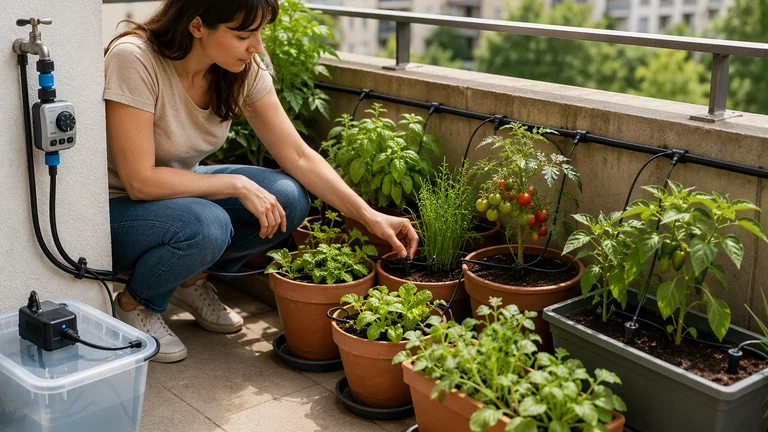
A properly designed micro-drip system can deliver water slowly near the root zone and reduce some evaporation and runoff compared with broad overhead irrigation.
But the hardware alone does not make a system water-smart.
Check:
- emitter placement,
- flow rate,
- pressure,
- leaks,
- clogged emitters,
- and whether every container is actually receiving the intended amount.
A leaking connector or badly positioned emitter can waste water even when the system is labeled “drip irrigation.”
Do Not Turn Irrigation Savings Into a Blanket Percentage Claim
Microirrigation can be more efficient than conventional spray irrigation in suitable applications, but that does not mean every balcony garden automatically reduces total water use by a fixed percentage.
A balcony starting from hand watering, self-watering containers or a very different crop mix has a different baseline.
For this reason, water savings should be measured against your own previous use rather than assumed from a generic percentage.
A Timer Is Useful, but a Timer Is Not a Moisture Sensor
Timers can help prevent forgotten watering, especially during travel or hot periods.
But a fixed timer does not automatically know whether:
- the weather became cooler,
- the balcony received rain,
- a plant was removed,
- a container is still wet,
- or an emitter has clogged.
Adjust schedules as weather and plant demand change.
Where appropriate, soil-moisture or weather-responsive controls can reduce unnecessary irrigation by preventing watering when it is not needed.
Self-Watering Containers Can Reduce Watering Stress
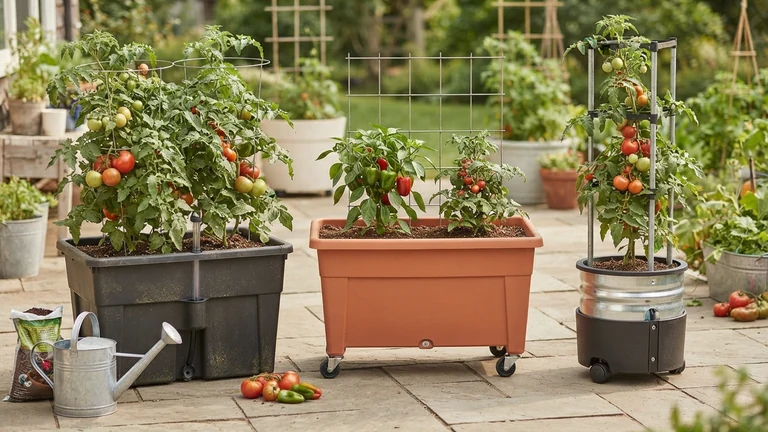
Self-watering planters can be useful on balconies because they store water in a reservoir that plants can access as the growing medium dries.
They are particularly useful where frequent hand watering is difficult.
But they still require management:
- the reservoir can run dry,
- different crops use stored water at different rates,
- and overflow or drainage design still matters.
They are a tool, not an automatic guarantee of lower water consumption.
Shade Should Reduce Heat Stress, Not Starve Crops of Light
Temporary shade can help during extreme heat, especially on exposed balconies.
But placing every container permanently in shade is not a water-saving strategy.
Tomatoes, peppers and many other fruiting crops require substantial light to perform well.
Use shade strategically:
- during extreme afternoon heat,
- for vulnerable young plants,
- or where reflected heat from walls and glazing becomes excessive.
The goal is to reduce damaging heat load without removing the light the crop needs.
Wind Can Increase Water Demand
Wind increases moisture loss from both plants and containers.
It can also make tall plants and trellises unstable.
On an exposed balcony:
- secure trellises,
- avoid top-heavy arrangements,
- group containers where appropriate,
- and monitor moisture more frequently during windy periods.
Choose Plants for the Site, Not for a “Drought-Tolerant” Label
A plant described as drought-tolerant may still require regular watering in a container.
Container-grown plants have a much smaller root zone than the same species growing in open soil.
Choose crops based on:
- available sunlight,
- container volume,
- climate,
- wind exposure,
- season,
- and how much irrigation you can realistically provide.
A water-smart edible balcony can include herbs, leafy greens, peppers, tomatoes and other container-suitable crops without pretending they are xeric plants.
Rainwater Can Be Supplemental, Not Assumed
If your building and local regulations permit rainwater collection, stored rainwater can supplement irrigation.
But balcony collection area is often small, and prolonged dry weather can empty a small reservoir quickly.
Do not design the entire irrigation strategy around rainwater unless the available catchment and storage capacity support it.
Plan Where Excess Water Goes
Balcony runoff is not only a horticultural issue.
It can affect:
- neighbors below,
- facades,
- balcony flooring,
- drainage systems,
- and building rules.
Test the drainage path before installing automated irrigation.
Automating an irrigation problem simply makes the problem happen on schedule.
Keep Weight and Access in the Design
Large containers, wet growing media and water reservoirs can become heavy.
Keep doors, drains and access paths clear, and respect building rules and any known balcony loading restrictions.
If structural capacity is uncertain, obtain appropriate building guidance before installing large planters or water-storage systems.
What a Water-Smart Balcony Cannot Guarantee
A water-smart design can improve control and reduce avoidable waste, but it cannot guarantee:
- a fixed percentage reduction in water use,
- minimal watering in every climate,
- zero plant stress during heat waves,
- identical irrigation intervals for every container,
- maximum yield,
- or successful crops regardless of sunlight.
Water efficiency comes from matching the system to the site and adjusting it as conditions change.
A Practical Water-Smart Balcony Workflow
- Map sun, heat and wind.
- Check drainage, building rules and usable access.
- Choose adequate container volumes.
- Select container materials with evaporation and heat in mind.
- Use an appropriate container-growing mix.
- Choose crops that fit the actual site.
- Group containers by similar water demand.
- Add suitable mulch where practical.
- Check root-zone moisture before irrigating.
- Use micro-drip or self-watering systems where they solve a real problem.
- Inspect emitters, reservoirs and drainage regularly.
- Adjust watering as weather and plant size change.
The Bottom Line
A water-smart balcony garden starts with container volume, drainage, root-zone moisture and a realistic understanding of the balcony microclimate.
Drip irrigation, mulch, self-watering planters and temporary shade can all help, but none replaces observation.
The most efficient system is the one that delivers enough water to healthy roots without routinely applying water the plants do not need.
FAQ
Can a balcony garden really use less water?
It can reduce avoidable water loss when container size, irrigation, mulch and plant grouping are designed well. The amount saved depends on what system you are comparing it with and should not be assumed as one universal percentage.
How often should I water balcony containers?
There is no universal interval. Check root-zone moisture and adjust for container size, plant size, heat, wind, sunlight and growing medium. Some containers may require daily attention during hot weather.
Is drip irrigation always the best option?
No. Drip irrigation can be very effective, but hand watering or self-watering containers may be simpler for very small balconies. The best method is the one you can control, inspect and maintain.
Are self-watering planters water-efficient?
They can reduce watering stress and provide plants with access to a stored reservoir, but they still require monitoring and appropriate overflow and drainage design.
Should I put plants in shade to save water?
Not automatically. Use shade to reduce excessive heat stress when needed, while still providing enough light for the crop you are growing.
Do drought-tolerant plants need little water in containers?
Not necessarily. Even drought-adapted plants can require regular watering when their roots are confined to containers.
What should I do first?
Observe sunlight, heat, wind and drainage, then choose adequately sized containers and group crops by compatible water needs before designing the irrigation system.
Build a More Resilient Garden
One practical system every Tuesday — water-smart gardening, food resilience, permaculture and small-space growing.
No fluff. No spam. Just practical systems that work.