Quick Verdict: When a Soaker Hose Makes Sense for Raised Beds
A soaker hose is usually a good fit for raised beds when you want simple, low-pressure watering without building a full drip-irrigation layout. It works best in short to medium runs, level beds and layouts where the hose can snake close to the root zone.
For most home raised beds, the buying decision comes down to five practical factors: hose length, pressure requirements, connector quality, durability and how evenly the hose releases water from the beginning to the end of the run.
If you want precise emitter-by-emitter control, drip irrigation is usually the better system. If you want a simpler setup with fewer fittings and easier seasonal removal, a soaker hose can be the better value.
What to Compare Before Buying
1. Hose Length
Match the hose length to the actual bed layout rather than buying the longest hose available. Longer runs can lose pressure toward the far end, especially when household pressure is low or several beds are connected together.
For a single 4 × 8 foot raised bed, a shorter hose is often easier to manage than a 50- or 100-foot coil. For several beds, separate zones generally work better than one very long continuous line.
2. Pressure Requirements
Soaker hoses are designed to operate at lower pressure than a normal open garden hose. Too much pressure can cause uneven seepage or shorten hose life. A pressure regulator is useful when your outdoor faucet delivers strong household pressure.
If the product documentation specifies a recommended PSI range, use that as the primary setup reference.
3. Connector Quality
Connectors are a common weak point. Look for secure threaded fittings, good washers and connectors that do not rotate loosely once installed. A durable hose with a poor end fitting can still become frustrating if it leaks at every connection.
4. Material and Durability
Rubber-style soaker hoses are flexible and easy to route around plants. Fabric-covered or reinforced designs may resist kinking better in some layouts. The best choice depends on whether the hose stays in place all season or is moved frequently.
For permanent seasonal installations, UV resistance and connector durability matter more than cosmetic flexibility.
5. Water Distribution
The key performance question is not simply whether the hose leaks water. It is whether the beginning, middle and end of the run receive reasonably similar flow.
Very long runs, elevation changes and high-pressure supply can all make distribution less even.
Best Soaker-Hose Setup by Raised-Bed Type
| Raised-bed situation | Best setup approach | What to prioritize |
|---|---|---|
| Single 4 × 8 bed | Short dedicated soaker hose | Simple routing, short run, easy timer connection |
| Two or three adjacent beds | Separate short zones from a splitter | Balanced pressure between beds |
| Long narrow bed | Straight or gently looping run | Even flow from start to finish |
| Multiple distant beds | Mainline plus separate soaker zones | Independent shutoff and pressure control |
| Container-heavy garden | Drip irrigation usually preferable | Emitter precision |
Soaker Hose vs Drip Irrigation
Soaker hose and drip irrigation solve the same basic problem in different ways.
| Factor | Soaker hose | Drip irrigation |
|---|---|---|
| Setup complexity | Low | Moderate |
| Number of fittings | Few | Usually more |
| Emitter precision | Low to moderate | High |
| Best for | Rows and compact raised beds | Mixed layouts and individual plants |
| Seasonal removal | Easy | Depends on layout |
| Expansion | Simple for small systems | Better for complex systems |
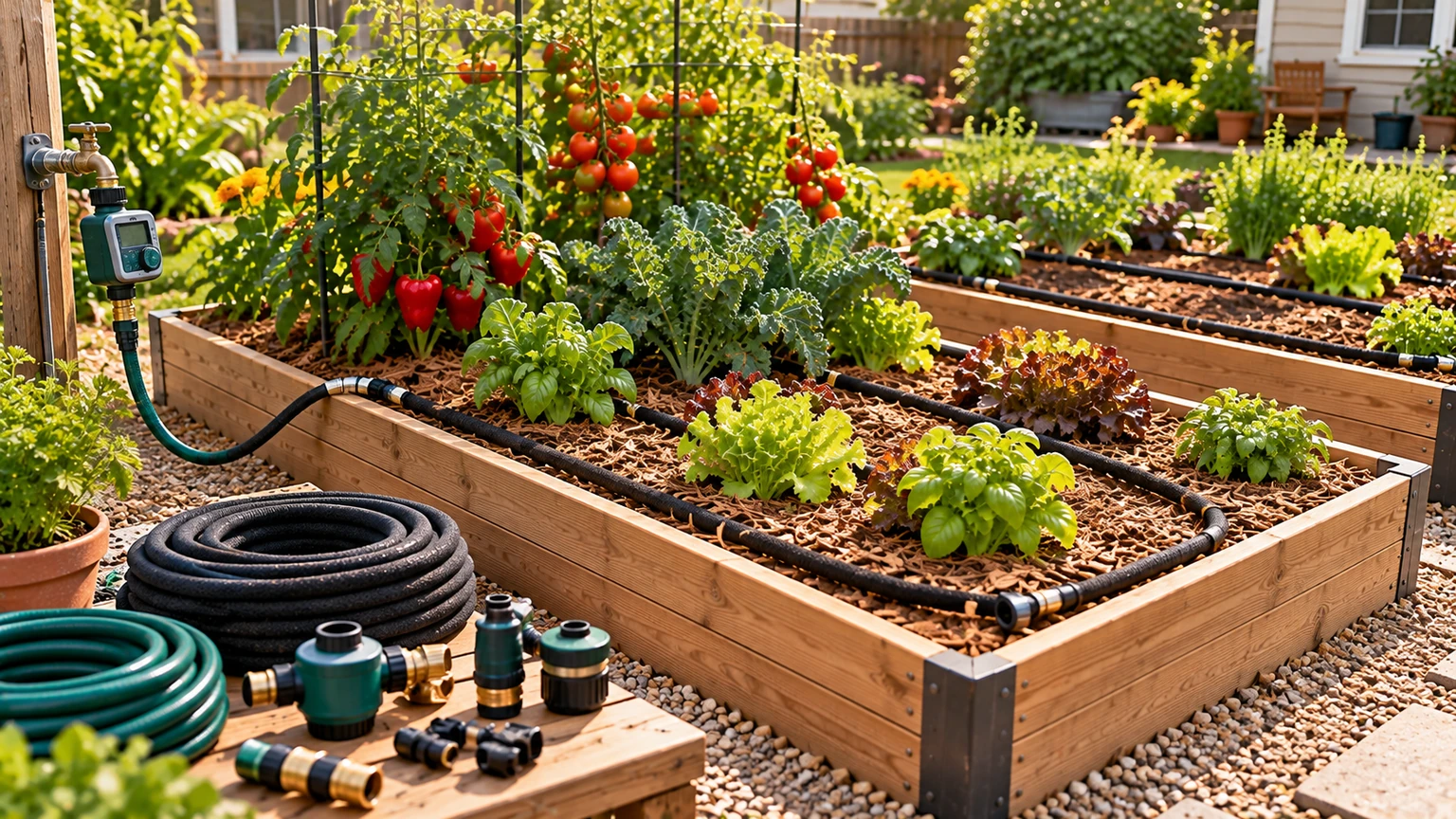
A soaker hose is usually the easier choice for a gardener who wants to connect a timer, lay the hose under mulch and water one or two beds with minimal plumbing. Drip becomes more attractive as the number of beds, containers and plant-specific watering zones increases.
How Much Hose Do You Actually Need?
Measure the bed before buying. Do not use bed perimeter alone; estimate the actual route the hose will follow through the root zone.
For a 4 × 8 foot bed, one or two gentle loops may require roughly 15 to 25 feet depending on plant spacing. A narrow single-row bed may need much less. The goal is to keep the hose near the crop roots without packing the bed with unnecessary tubing.
If the calculated route becomes very long, split the system into two shorter runs rather than forcing one hose to serve everything.
Spacing Inside the Bed
Spacing depends on soil texture and how quickly water spreads sideways.
- Heavier soil: water spreads laterally more easily, so wider spacing may work.
- Sandy or very loose mixes: water tends to move downward faster, so closer hose spacing may be useful.
- Dense planting: route the hose close to the main root zones instead of watering the entire surface equally.
A good starting point is to observe the moisture pattern after the first irrigation cycle and adjust the layout before covering the hose with mulch.
Timer Compatibility
A timer can make a soaker-hose system much more useful because the hose is designed for slow watering rather than quick manual soaking.
Before buying, check that your timer, pressure regulator and hose connectors all use compatible threads. If you need adapters, include them in the purchase plan rather than discovering the mismatch during installation.
For multiple beds, a splitter with independent shutoff valves can make seasonal adjustment easier.
When a Soaker Hose Is the Better Buy
A soaker hose is a strong choice when:
- you have one to three raised beds;
- the beds are close to the water source;
- the ground is relatively level;
- you want fewer fittings than a full drip system;
- you plan to cover the hose with mulch;
- you want an inexpensive, easy-to-understand irrigation setup.
When You Should Choose Drip Instead
Drip irrigation is usually a better fit when:
- you need precise watering for individual plants;
- you have beds, containers and hanging planters in the same system;
- the watering zones are far apart;
- you want separate flow rates for different crops;
- your layout is likely to expand significantly.
Buying Checklist
- Measure the actual hose route through each bed.
- Check the recommended operating pressure.
- Confirm whether a pressure regulator is needed.
- Inspect connector construction and washer quality.
- Confirm timer compatibility.
- Decide whether one long hose or several short zones is better.
- Check whether repair fittings are available.
- Plan mulch placement after testing the water pattern.
What Matters More Than Brand Names
For a raised-bed system, a famous brand name does not automatically make a hose the best choice. The correct length, pressure range, durable connectors and even water release matter more than marketing claims.
If two products are similar, choose the one that fits your bed dimensions and plumbing with the fewest adapters. A simple system that is easy to repair and control is usually more valuable than a feature-heavy product that does not match the layout.
Bottom Line
For most small raised-bed gardens, the best soaker-hose system is a short, low-pressure, timer-compatible setup with durable connectors and separate control for each bed or small group of beds.
Choose soaker hose when simplicity and low setup complexity matter most. Choose drip irrigation when precision, expansion and plant-by-plant control matter more. The best purchase is the system that matches the physical garden rather than the longest hose or most heavily marketed kit.