Reading Time: 7 min read
Can You Still Water an Apartment Garden in California in 2026?
Usually, yes — but the answer depends on your local water supplier, city or water district, not on a single statewide rule that applies identically to every balcony or patio garden.
California's statewide emergency water-conservation regulations have expired, but local authorities can still impose different or stricter watering rules. That means a renter in Los Angeles, San Diego, Sacramento or another California city may face different schedules or restrictions.
For apartment gardeners, the practical rule is simple:
Check the current rules for your address or water supplier before assuming that outdoor watering is allowed on any particular day or at any particular time.
What Changed in California?
California has moved away from relying only on temporary emergency drought rules toward a longer-term water-efficiency framework.
The state's “Making Conservation a California Way of Life” regulation took effect in 2025 and establishes efficiency objectives for urban water suppliers.
For renters, however, that does not translate into one universal balcony-garden watering schedule.
Your actual restrictions may still come from:
- your local water supplier,
- your city or county,
- your apartment building or landlord,
- or temporary local drought measures.
Step 1: Check the Rule That Actually Applies to Your Address
Before changing your garden setup, identify who supplies water to your building.
Then check:
- allowed outdoor watering days,
- watering-hour restrictions,
- hand-watering exemptions or conditions,
- drip-irrigation rules,
- runoff restrictions,
- and any temporary drought-stage requirements.
Local rules matter because California explicitly allows water suppliers and local authorities to adopt stricter conservation measures than statewide requirements.
Step 2: Treat a Balcony Garden Differently from a Lawn
A few containers of tomatoes, peppers or herbs are not operationally the same as irrigating a large lawn.
Container gardens use far less total area, but they can also dry out rapidly because the root zone is exposed to heat and wind on all sides.
That makes precision more important than simply watering less often.
The goal is:
apply the amount of water the container can actually hold and use, without allowing excess water to run across the balcony, patio or sidewalk.
Step 3: Use Containers That Reduce Water Waste
The container itself has a major effect on water use.
Useful options include:
- larger containers with adequate root volume,
- self-watering or sub-irrigated planters,
- containers with proper drainage but enough growing media to buffer heat,
- and grouped pots that reduce exposure to hot reflected surfaces.
Very small containers dry out quickly and may force you to irrigate more frequently during warm weather.
Step 4: Mulch Container Soil
A thin layer of appropriate mulch can reduce direct evaporation from the surface of a large planter.
Keep mulch away from the base of stems and make sure the container still drains properly.
Mulch does not eliminate watering, but it can reduce unnecessary surface moisture loss.
Step 5: Water the Root Zone, Not the Balcony
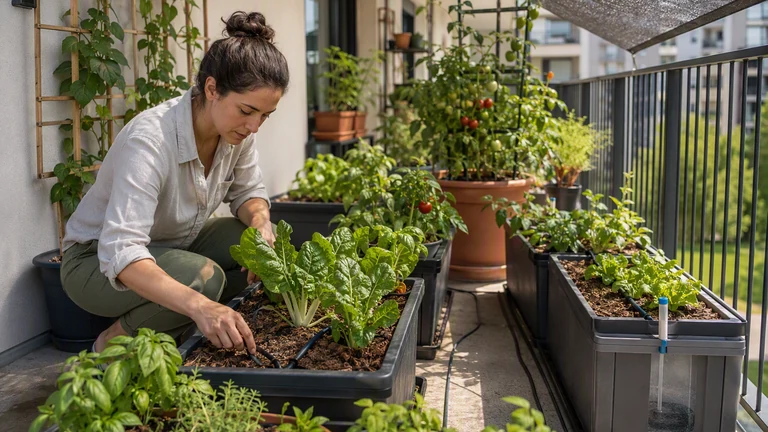
Hand watering or low-flow drip delivery can be more precise than spraying containers from above.
Apply water slowly enough that the growing medium can absorb it.
Stop if water is simply running through the container or across a hard surface.
Water waste and runoff are exactly what efficient irrigation practices are designed to avoid.
Step 6: Check Soil Moisture Instead of Following a Blind Calendar
Container moisture changes rapidly with:
- temperature,
- wind,
- container size,
- plant size,
- sun exposure,
- and the growing medium.
Check the actual root-zone moisture before watering.
A tomato in a large container during a hot California afternoon may use water very differently from rosemary growing in a shaded pot.
What Crops Make Sense for a Water-Conscious Apartment Garden?
If your goal is food production, prioritize crops that fit your available sunlight, container size and actual household use.
Herbs
Rosemary, thyme and some Mediterranean herbs can tolerate relatively dry conditions once established, although container-grown plants still require monitoring.
Peppers
Peppers can be a useful compact fruiting crop for sunny balconies and patios.
They still require consistent moisture during growth and fruit production.
Cherry Tomatoes
Tomatoes can be productive in containers but are not low-water plants.
If you grow them, use an adequately sized container and focus on efficient root-zone watering rather than assuming they are drought tolerant.
Leafy Greens
Greens can be productive in smaller spaces but may require more frequent moisture monitoring during hot weather.
They can be more practical during cooler parts of the season.
Do Not Confuse Drought-Tolerant Landscaping with Vegetable Gardening
Succulents, cacti and drought-tolerant ornamentals can be excellent choices for low-water decorative landscapes.
But they do not solve the same problem as growing tomatoes, peppers, herbs or greens for food.
A renter who wants edible crops should choose efficient containers, good growing media and appropriate crop varieties rather than replacing the food garden with purely ornamental drought-tolerant plants.
Can You Collect Rainwater?
Rainwater collection rules and building logistics vary.
For renters, the first questions are practical:
- Does the landlord or building permit collection equipment?
- Can the container be installed safely without creating structural or drainage problems?
- Are there local rules affecting how captured water can be stored or used?
Do not assume that a balcony rain barrel is automatically appropriate simply because rainwater harvesting is discussed as a conservation technique.
What About Graywater?
Graywater is a separate plumbing and building-code issue, not a casual substitute for ordinary container irrigation.
California has specific rules governing onsite nonpotable-water reuse, and local jurisdictions can impose additional requirements.
For most apartment renters, installing or modifying a graywater system is not a do-it-yourself balcony-gardening decision.
Do not divert sinks, showers or laundry water into edible-container gardens without confirming building, plumbing and local requirements.
Apartment Building Rules Matter Too
Even when local water rules allow irrigation, your lease or building rules may restrict:
- drainage from balconies,
- water running onto units below,
- container weight,
- attachment of irrigation equipment,
- or installation of large water-storage containers.
For renters, compliance therefore has two layers:
local water rules + property rules.
A Practical Water-Smart Balcony Setup
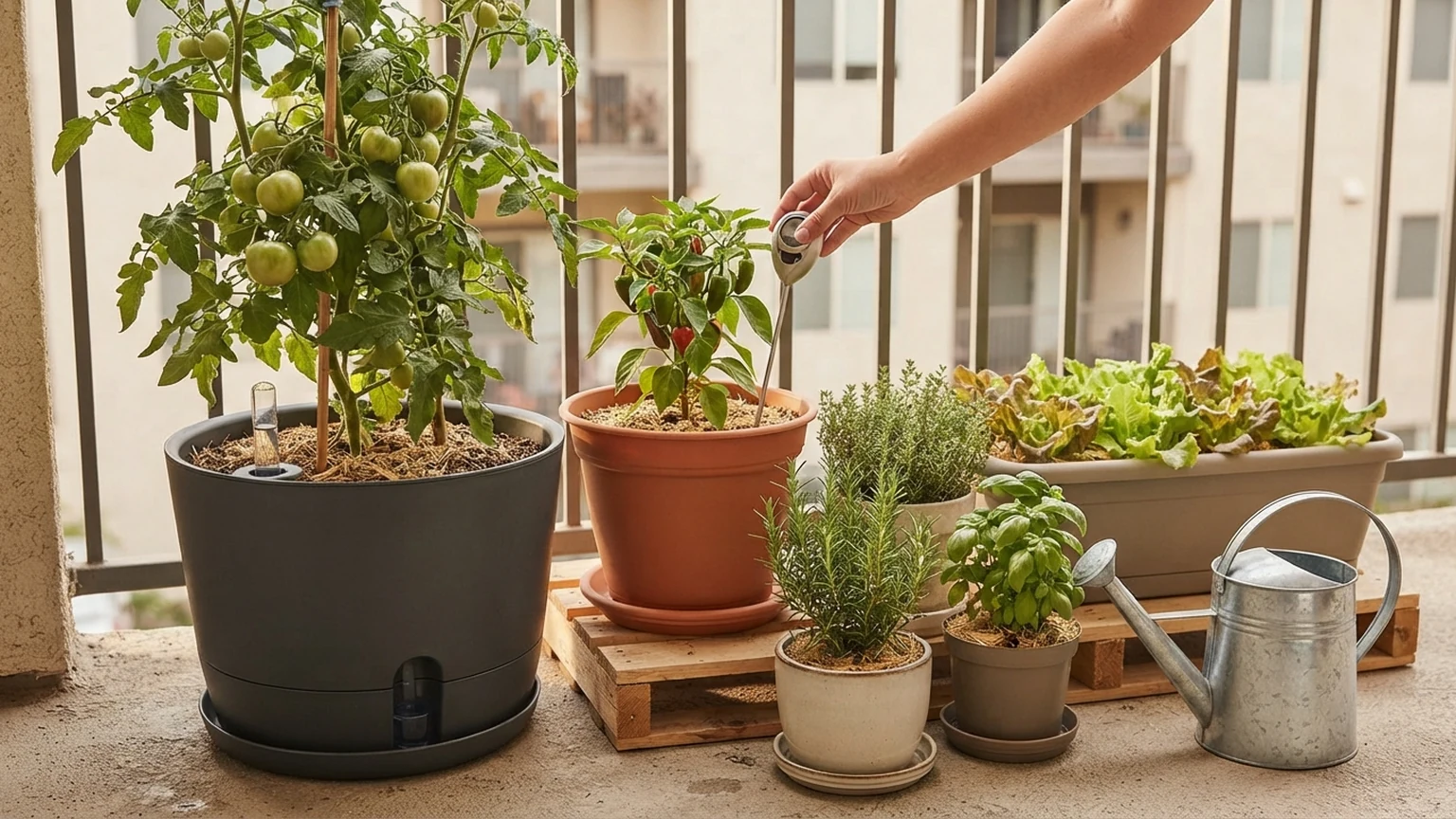
A simple setup might include:
- one large self-watering tomato container,
- one pepper container,
- two or three herb pots,
- a shallow seasonal greens container,
- mulch where appropriate,
- and a watering can or low-flow delivery method.
This approach is easier to monitor than dozens of small pots and gives plants more stable root-zone moisture.
What to Do During a Local Watering Restriction
When a local restriction is announced:
- Find the exact rule from your water supplier or city.
- Confirm whether it applies to container plants, hand watering or drip systems.
- Check permitted days and hours.
- Inspect soil moisture before watering.
- Use slow, targeted irrigation.
- Prevent runoff.
- Prioritize edible plants that genuinely need water.
Do not rely on an old statewide drought schedule or a social-media post from another city.
Reality Check: There Is No Single California Balcony Watering Rule
This is the most important point in the guide.
California establishes statewide conservation policy, but actual restrictions can vary by supplier and locality.
A renter should not assume that a rule reported in another California city applies to their apartment.
Check locally, then design the garden to make compliance easy.
The Bottom Line
Yes, you can usually maintain an apartment food garden in California in 2026 — but you need to follow the rules that apply to your actual water service area and property.
The most reliable strategy is not to chase a universal “drought-proof garden.”
Instead:
- check local restrictions,
- use appropriately sized containers,
- water the root zone precisely,
- reduce evaporation and runoff,
- choose crops that fit your conditions,
- and confirm building rules before adding collection or reuse systems.
FAQ
Can I still water my apartment garden during California water restrictions?
Often yes, but the applicable rules can vary by local water supplier, city or district. Check the current restrictions for your address, including permitted days, hours and irrigation methods.
Are California watering restrictions the same everywhere?
No. Local authorities and water suppliers can adopt different or stricter conservation measures.
Are self-watering planters useful during restrictions?
They can help reduce waste by storing water in a reservoir and supplying moisture to the root zone, but they still require monitoring and refilling.
Can I use graywater for my balcony vegetables?
Do not assume so. Graywater reuse is subject to plumbing, building and local requirements, and apartment renters generally need to consider landlord and building restrictions as well.
Can I collect rainwater on an apartment balcony?
Possibly, but building rules, structural considerations, drainage and local requirements should be checked before installing a collection system.
What is the most important water-saving change?
Use the right-sized container and deliver water directly to the root zone only when the growing medium actually needs it.