Reading Time: 11 min read
What Makes a Small-Space Rainwater System Actually Work?
A useful rainwater system is not simply the biggest tank you can fit into a corner.
For balconies, patios, narrow side yards and compact backyards, the best system is the one that matches five things:
- the catchment surface you actually control,
- the amount of storage you have room for,
- the amount of water your garden can realistically use,
- a safe overflow route,
- and the rules that apply to the property.
The best small-space rainwater system is not the one that stores the most water. It is the one that matches your catchment area, storage space, garden demand, overflow route and local rules.
That is why a compact barrel can outperform a larger tank in one garden, while a slimline tank or gravity-fed system makes more sense somewhere else.
System 1 — Compact Rain Barrel
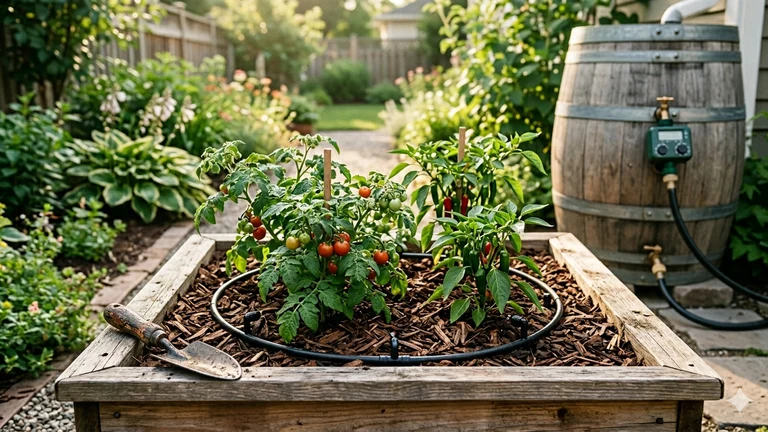
A compact rain barrel is the simplest option for many small backyards, patios and side yards.
It works best when you have:
- access to a downspout you are allowed to modify or divert,
- a stable surface for the barrel,
- a nearby garden bed or container group,
- and a safe place for overflow.
A typical small barrel stores only a fraction of the runoff that can come from a roof during a meaningful rain event, so storage capacity is often the limiting factor.
That does not make the system ineffective. It simply means the barrel must be used and emptied between storms if you want to capture more water over time.
Best for
- small backyards,
- patio gardens,
- raised beds close to a downspout,
- and gardeners who want the simplest entry point.
Main limitation
Storage fills quickly, so overflow management matters.
System 2 — Slimline Wall Tank
A slimline tank is useful when floor area is limited but a narrow strip of wall space is available.
Instead of using a wide barrel footprint, the tank stores water vertically along a wall or fence line.
This can be useful beside:
- a townhouse,
- a garage,
- a narrow patio,
- a side passage,
- or a compact backyard wall.
The key advantage is space efficiency.
The main trade-off is that a larger water volume also means more weight, more demanding support requirements and potentially more complex overflow routing.
A slimline rainwater tank should not automatically be treated as a graywater tank. Rainwater and graywater are separate water sources with different collection, storage and use considerations.
Best for
- narrow outdoor spaces,
- wall-adjacent installations,
- gardens that need more storage than a small barrel can provide.
Main limitation
Weight, support and access can become more important as tank size increases.
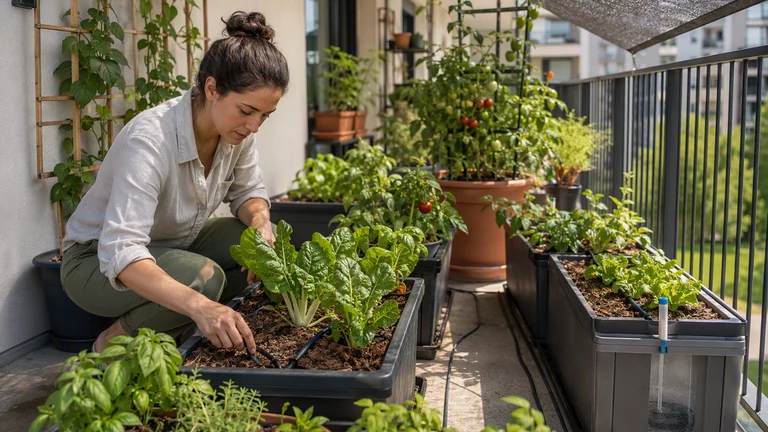
System 3 — Balcony-Safe Small Catchment Setup
Balconies require more caution than backyards because the collection surface, drainage system and exterior structure may not belong exclusively to the resident.
Do not assume that you can modify a shared downspout, building gutter or façade drainage route.
Before building a balcony rainwater system, check:
- building rules,
- landlord or property-manager requirements,
- HOA or condominium rules where applicable,
- local drainage requirements,
- and whether you actually control the catchment surface.
A balcony-safe setup is usually smaller and simpler than a roof-fed backyard system.
It may use a small legal catchment surface you control, such as an approved awning, mini greenhouse roof or other dedicated surface, with water directed into a compact covered container.
Do not direct overflow onto neighboring property, walkways or the building façade.
Best for
- renters,
- balcony container gardens,
- very small-space growers,
- and locations where only limited catchment is available.
Main limitation
Building rules and structural constraints may matter more than storage capacity.
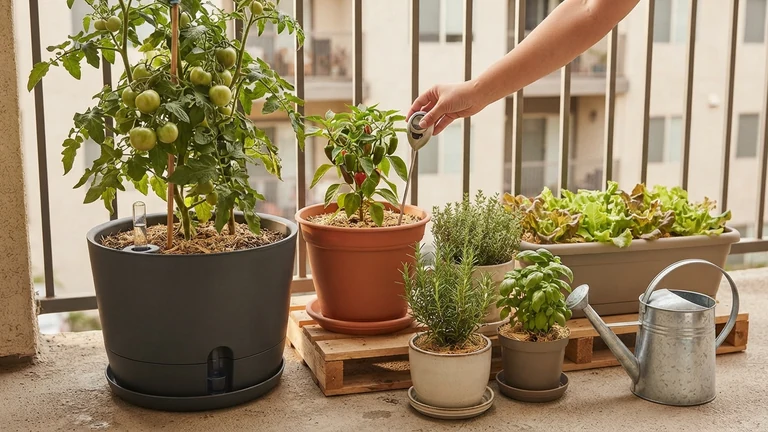
System 4 — Rainwater-Fed Wicking Container
A wicking container stores water below or within the growing system and allows moisture to move upward toward the root zone by capillary action.
Rainwater can be added to the reservoir manually or through a carefully designed collection arrangement.
This type of system is useful because it separates storage from surface watering.
Instead of repeatedly wetting the top of the growing medium, the reservoir supplies moisture from below as the container dries.
A wicking system still needs:
- a defined maximum water level,
- an overflow point,
- suitable growing media,
- and periodic inspection.
It should not be treated as maintenance-free.
Best for
- patios,
- balconies where permitted,
- container vegetables,
- herbs,
- and gardeners who want a buffer against rapid drying.
Main limitation
The reservoir is small, so the system still depends on rainfall frequency, refill strategy and plant demand.
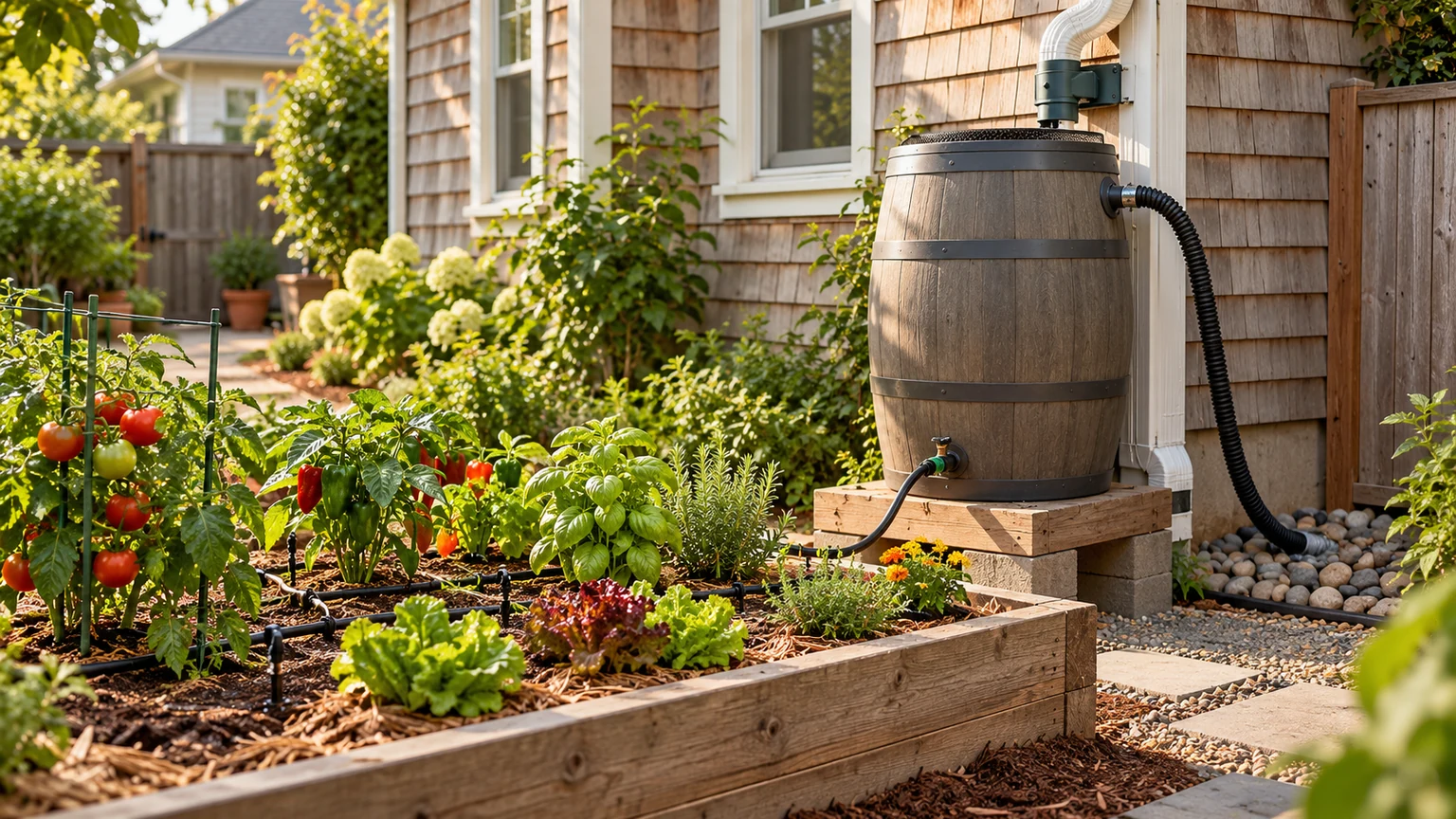
System 5 — Gravity-Fed Drip From a Small Tank
A small tank can feed drip irrigation without a pump if there is enough elevation and the irrigation hardware is compatible with low pressure.
This is one of the most useful combinations for small-space gardening because stored rainwater can be delivered directly to:
- containers,
- raised beds,
- herb planters,
- and small vegetable plots.
But gravity-fed drip has limits.
Pressure depends largely on the height difference between the water level and the emitters.
A barrel sitting only slightly above the garden does not behave like a pressurized household water supply.
That means some standard drip components may perform poorly if they require more pressure than the tank can provide.
For a low-pressure system, keep the layout simple and use components suited to gravity-fed irrigation.
Best for
- raised beds below the tank,
- short drip lines,
- simple one-zone irrigation,
- and gardeners who want water delivery without a pump.
Main limitation
Low pressure can limit flow and emitter performance.
Which System Fits Your Space?
Use the simplest system that solves your actual problem.
- Small backyard near a downspout: compact rain barrel.
- Narrow side yard: slimline wall tank.
- Balcony or rental: small approved catchment only after checking building rules.
- Containers that dry quickly: rainwater-fed wicking setup.
- Raised bed below stored water: gravity-fed drip.
You can also combine systems.
For example, a compact barrel can feed one short gravity-drip line, or stored rainwater can be transferred manually into wicking-container reservoirs.
Storage Capacity Is Not the Same as Catchment Potential
One of the most important rainwater-harvesting concepts is the difference between how much water a surface can produce and how much water your system can store.
A useful planning estimate for roof runoff is:
Potential roof capture ≈ roof area × rainfall × 0.623 gallons per square foot per inch of rain.
For example:
500 sq ft × 1 inch of rain × 0.623 ≈ 312 gallons of theoretical runoff.
That does not mean a 55-gallon barrel suddenly stores 312 gallons.
It means the roof may generate much more water than the barrel can hold.
Your real usable capture depends on:
- storage capacity,
- how much water is already in the tank before a storm,
- how quickly you use stored water,
- overflow losses,
- and collection efficiency.
Overflow Is Part of the System
Every rainwater container needs a plan for what happens when it becomes full.
Overflow should be routed away from:
- building foundations,
- doorways,
- walkways,
- neighboring property,
- and areas where water could cause erosion or damage.
Do not treat overflow as an afterthought.
It is a normal part of rainwater-system design.
Keep Mosquitoes Out
Stored rainwater should not provide easy access for mosquitoes.
Use:
- proper screening at inlets and openings,
- a secure cover where appropriate,
- screened or protected overflow openings,
- and regular inspection for gaps or damaged screens.
A rainwater system should not contain open, stagnant water that mosquitoes can easily reach.
First-Flush and Debris Control
Roof runoff can carry leaves, dust, pollen and other debris into storage.
Depending on the catchment surface and system, useful measures may include:
- gutter cleaning,
- leaf screens,
- inlet screens,
- and an optional first-flush diverter.
A first-flush device can divert an initial portion of runoff before later water enters storage, but it should be sized and maintained appropriately rather than treated as a universal requirement.
What Gravity Flow Can and Cannot Do
Gravity flow is convenient, but the available pressure is modest in most small systems.
Higher water elevation generally creates more pressure, while long tubing runs, restrictive fittings and incompatible emitters can reduce performance.
For a simple gravity-fed garden system:
- keep tubing runs reasonably short,
- avoid unnecessary fittings,
- use low-pressure-compatible irrigation components,
- and test the actual flow before expanding the system.
Do not assume that hardware designed for household water pressure will perform the same way from a rain barrel.
Balcony Weight Matters
Water is heavy.
Even a compact container can impose substantial load when full.
On balconies, rooftops and elevated structures, do not assume that a larger tank is acceptable simply because it physically fits.
Follow building requirements and obtain appropriate approval or professional guidance where structural loading is uncertain.
Rainwater Is Not Automatically Potable Water
This guide focuses on garden irrigation.
Collected rainwater should not automatically be treated as safe drinking water or as a universal substitute for household plumbing water.
Uses such as indoor plumbing, toilet flushing or other building-connected applications can involve additional treatment, plumbing, backflow and regulatory requirements.
For a small GardHack garden system, the simplest and clearest use is irrigation.
What About Washing Cars or Other Outdoor Uses?
A stored rainwater supply can sometimes be used for other non-potable outdoor tasks where local rules permit, but those uses are secondary to the garden system described here.
If your goal is keeping a small garden resilient, use the limited stored water where it provides the most value to your plants.
Rainwater and Graywater Are Not the Same System
Rainwater comes from precipitation collected from an appropriate surface.
Graywater comes from household wastewater streams such as some sinks, showers or laundry sources, depending on local definitions.
Do not assume that a tank suitable for rainwater automatically creates a compliant graywater system.
The two should be planned separately unless you have verified the applicable rules and technical requirements.
A Simple Decision Framework
Before buying hardware, answer these questions:
- What surface will collect the rain?
- Do I control that surface?
- How much storage can the space safely support?
- How much water does the garden realistically use?
- Where will overflow go?
- Can gravity deliver water to the garden?
- Do I need a barrel, slim tank, wicking reservoir or drip line?
- What building or local rules apply?
If you can answer those questions, choosing the hardware becomes much easier.
The Bottom Line
Small-space rainwater harvesting works best when the system is matched to the space instead of copied from a large-property design.
The five useful approaches are:
- compact rain barrel,
- slimline wall tank,
- balcony-safe small catchment,
- rainwater-fed wicking container,
- and gravity-fed drip from a small tank.
None of them is universally best.
Choose based on catchment, storage, garden demand, pressure, overflow and property rules.
In a small garden, a well-matched 40- or 60-gallon system that you actually use can be more useful than a much larger tank that does not fit the space or the garden.
FAQ
What is the simplest rainwater system for a small backyard?
A compact rain barrel connected to an appropriate downspout is often the simplest starting point, provided you have permission to use the catchment and a safe overflow route.
Can I install a rain barrel on a balcony?
Possibly, but do not assume that it is automatically allowed or structurally appropriate. Check building rules, landlord or property-manager requirements, local drainage rules and allowable loading before installing stored water on an elevated structure.
Can a rain barrel run drip irrigation?
Yes, in some setups. Gravity-fed drip can work when the tank is elevated enough and the irrigation components are compatible with low pressure. Keep the system simple and test actual flow.
Do I need a pump?
Not always. Short, low-pressure irrigation layouts can sometimes run by gravity. A pump becomes useful when the system requires more pressure, longer runs or more demanding irrigation hardware.
How do I keep mosquitoes out of stored rainwater?
Use secure screening at openings, keep the storage container appropriately covered and inspect screens, overflow points and fittings regularly.
Can I use rainwater for indoor plumbing?
That is outside the scope of this small-garden guide. Building-connected indoor uses may involve treatment, plumbing, backflow prevention and regulatory requirements that differ substantially from simple garden irrigation.
Is a slimline tank better than a barrel?
Not automatically. A slimline tank is useful when wall space is available and you need more storage, while a barrel is often simpler and cheaper. The better choice depends on space, weight, access, catchment and garden demand.
What is the most important design feature?
A safe overflow route. Every storage container eventually fills, so you need to know where excess water will go before installing the system.
Build a More Resilient Garden
One practical system every Tuesday — water-smart gardening, food resilience, permaculture and small-space growing.
No fluff. No spam. Just practical systems that work.