Reading Time: 11 min read
Practical Permaculture for Balconies and Apartments: Design Around Space, Water and Real Constraints
As urban populations continue to grow, finding ways to cultivate food and community in small spaces is becoming increasingly important. For renters and urban dwellers, having a balcony or apartment with limited outdoor space can be a challenge when it comes to growing their own food.
Practical balcony and apartment permaculture offers a systems-oriented way to work with limited space, water, sunlight and access. Instead of trying to maximize plant density, the goal is to match containers, crops, irrigation and vertical structures to the actual conditions of the apartment or balcony. Rainwater capture, self-watering containers and vertical growing can be useful in some situations, but structural limits, building rules, drainage, climate and available light determine what is realistic.
Apartment Permaculture Starts With Constraints, Not More Plants
You do not need a yard to use permaculture principles, but an apartment or balcony changes the design problem.
The first questions are not “What can I grow?” or “How many containers can I fit?” They are:
- How much direct sunlight reaches the space?
- How strong is the wind?
- Where can excess water drain?
- How much weight can the balcony safely support?
- What do the lease, building rules or local regulations allow?
- How much daily maintenance can you realistically provide?
Apartment permaculture is less about reproducing a backyard ecosystem and more about arranging limited space, water, access and plant choices intelligently.
Observe the Microclimate Before Buying Containers
Balconies can behave very differently from ground-level gardens.
A south- or west-facing balcony may become much hotter than the surrounding air. Upper floors can experience stronger wind. Walls can reflect heat, while overhangs and neighboring buildings can reduce direct sunlight.
Before planting, observe the space at several times during the day and record:
- hours of direct sun,
- areas of persistent shade,
- wind exposure,
- heat reflected from walls or glass,
- where rain actually reaches,
- and where irrigation water can safely drain.
This information should determine crop choice and container placement.
Balcony Load Comes Before Garden Density
Containers become heavy when they are filled with wet growing medium and mature plants.
Large planters, water-storage containers and dense groups of pots can create substantial concentrated loads.
Do not assume that an available balcony corner is automatically suitable for a large planter or rain barrel.
Before adding heavy systems, consider:
- building or lease restrictions,
- structural load limits,
- the weight of wet growing medium,
- the weight of stored water,
- and how that weight is distributed.
If the safe load is uncertain, use smaller containers and avoid concentrated water storage until the building requirements are clear.
Keep Access and Emergency Routes Clear
A balcony garden should never block doors, fire escapes, drainage points or required access routes.
Vertical systems and hanging planters are useful only when they are securely mounted and do not interfere with railings, neighbors or building safety requirements.
Think of circulation as part of the garden design.
Use Vertical Space Without Creating a Wind Sail
Vertical growing can be extremely useful in apartments because floor area is limited.
Good candidates include climbing beans, peas, compact cucumbers and some small-fruited tomatoes, depending on climate and container volume.
But tall trellises and dense vines can catch significant wind.
A useful vertical system should be:
- securely anchored,
- appropriate for the balcony structure,
- kept clear of neighboring property,
- and sized so that mature plants remain manageable.
Do not rely on a lightweight freestanding trellis in a highly exposed location simply because it saves floor space.
Choose Crops for Container Reality
Apartment food growing becomes easier when plant size matches available root volume.
Good candidates for many small spaces include:
- leaf lettuce,
- arugula,
- spinach in suitable seasons,
- basil, parsley, thyme and other compact herbs,
- radishes,
- compact peppers,
- patio or dwarf tomatoes,
- and climbing crops where adequate support is available.
The best choice depends on climate, sunlight and container depth.
A large crop in an undersized container usually creates more watering and nutrient problems than a smaller crop in an appropriately sized container.
Use Containers as Movable Micro-Zones
One advantage of apartment gardening is that containers can be repositioned.
You can treat them as small functional zones:
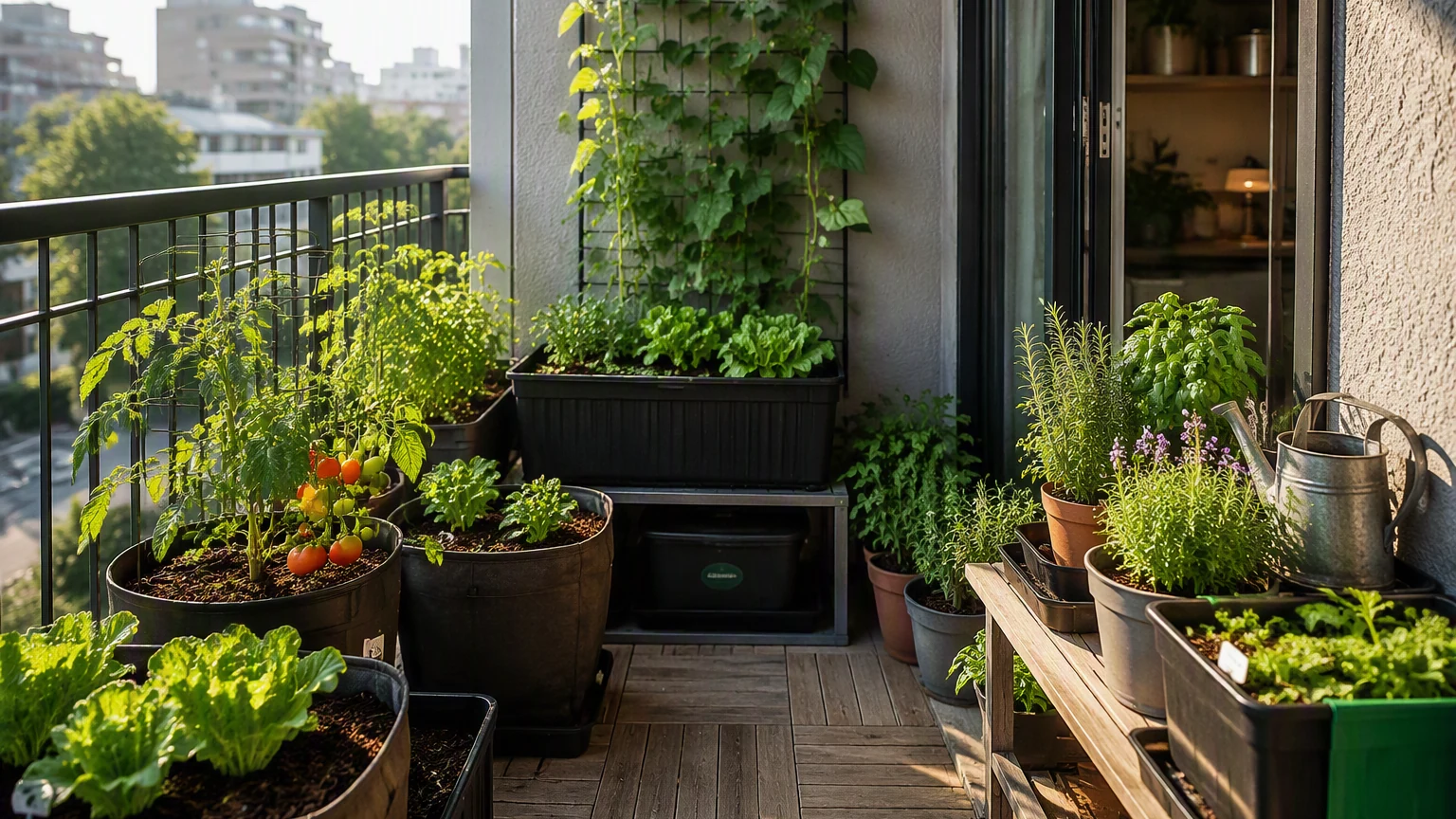
- Near the door: herbs and greens harvested frequently.
- Sunniest position: tomatoes, peppers and other high-light crops.
- Partial shade: crops that tolerate lower light or benefit from protection during hot periods.
- Vertical edge: climbing crops where supports can be anchored safely.
This is a simple apartment-scale version of permaculture zoning: frequently used elements stay convenient, while less demanding elements occupy less accessible space.
Water Management Matters More in Containers
Containers have much less stored moisture than garden soil, so they can dry quickly in hot or windy conditions.
The goal is not to “minimize water” at any cost. The goal is to deliver enough water efficiently and consistently.
Useful options include:
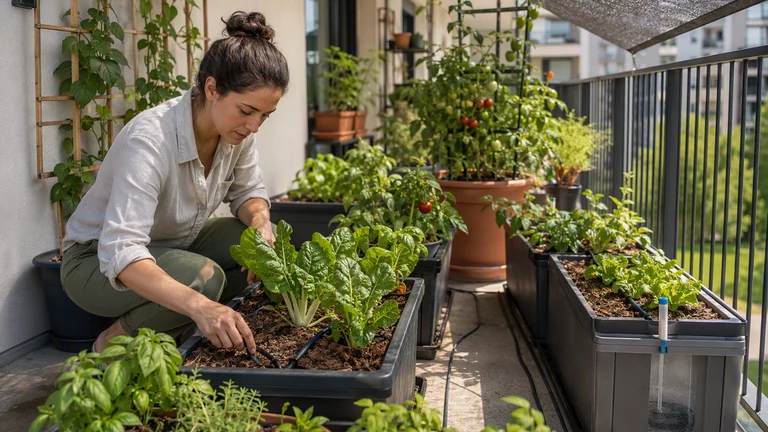
- drip emitters designed for containers,
- self-watering planters,
- mulch on suitable larger containers,
- grouping plants with similar moisture needs,
- and checking the growing medium before watering again.
A fixed schedule should not replace observation. Container demand changes with weather, plant size, wind and season.
Self-Watering Planters Can Reduce Watering Stress
Self-watering containers can be useful where daily watering is difficult.
They typically store water in a lower reservoir and allow moisture to move into the root zone.
They do not eliminate maintenance, and they should still be checked for:
- reservoir level,
- overflow function,
- root-zone moisture,
- and salt accumulation from fertilizers or hard water.
Rainwater Harvesting on a Balcony Needs More Caution
Rainwater collection is often associated with permaculture, but a conventional rain barrel is not automatically appropriate for an apartment balcony.
A large volume of stored water is heavy. In addition, the balcony may receive little usable roof runoff unless it has a dedicated and permitted catchment.
Before installing any storage system, verify:
- whether the lease or building rules permit it,
- whether the structure can safely support the load,
- where the water is actually coming from,
- how overflow will be managed,
- and whether mosquitoes or debris can enter the container.
In many apartments, efficient irrigation and modest container storage may be more practical than installing a full-size rain barrel.
Drainage Must Not Become a Problem for Neighbors
Water leaving containers has to go somewhere.
Do not design a watering system that regularly sends runoff over a balcony edge or onto the property below.
Use saucers, drainage trays or appropriate collection methods where needed, while still preventing containers from remaining permanently waterlogged.
Good apartment garden design includes the destination of excess water.
Composting Is Possible — But Scale Matters
A traditional outdoor compost pile is rarely practical on a balcony.
Smaller options can include properly managed worm composting or another enclosed system permitted by the building.
The system should be sized to the amount of material you actually generate and managed to avoid:
- odors,
- flies,
- excess moisture,
- and leakage.
Composting is not required for apartment permaculture. It is useful only when the system fits the space and can be maintained properly.
Indoor Growing and Balcony Growing Are Different Systems
A sunny balcony and an indoor windowsill should not be treated as equivalent growing environments.
Indoor plants may receive substantially less usable light even when placed near a window.
Some herbs and leafy greens can work indoors under suitable conditions, but reliable year-round production may require supplemental lighting and environmental control.
Therefore, “fresh produce year-round” should be treated as a possible outcome for particular setups, not as a default result of apartment permaculture.
Stack Functions, Not Containers
Permaculture often emphasizes elements that perform more than one useful function.
In an apartment garden, practical examples include:
- a trellis that supports vines and provides limited seasonal shade,
- herbs that provide food while adding floral resources when allowed to flower,
- a self-watering planter that provides both root space and water storage,
- or a storage bench that organizes tools while keeping the garden uncluttered.
The goal is not to make every object complicated. A simple system that performs two jobs reliably is often better than a dense arrangement that is difficult to maintain.
Small Spaces Reward Succession Planting
When growing area is limited, timing can be as valuable as vertical space.
A fast crop can be harvested before a slower crop fills the container or nearby area.
Depending on climate, examples can include:
- radishes before larger warm-season crops mature,
- leaf lettuce during cooler periods,
- herbs harvested repeatedly through the season,
- and replacing finished crops rather than leaving containers empty.
Planting dates should follow local conditions rather than a universal calendar.
Do Not Confuse Plant Diversity With Overcrowding
Permaculture values diversity, but an apartment garden still has physical limits.
Too many plants in one container can create:
- root competition,
- rapid water depletion,
- poor airflow,
- difficult pest inspection,
- and smaller or stressed plants.
Diversity should improve the system, not make it harder to manage.
Pest Management Starts With Observation
Apartment gardens can still develop aphids, whiteflies, mites and other pests.
The first response should be identification and monitoring rather than automatically applying a pesticide.
Depending on the pest and severity, management may include:
- removing heavily affected plant material,
- washing some pests from sturdy plants,
- improving airflow or spacing,
- isolating an affected container,
- or using an appropriate labeled treatment when necessary.
Products such as insecticidal soaps, horticultural oils or other controls have specific label instructions and crop restrictions. They should not be presented as universal solutions.
Disease Management Is Mostly Prevention and Diagnosis
Leaf spots, wilting or discoloration do not automatically mean a fungal disease.
Similar symptoms can result from:
- overwatering,
- poor drainage,
- nutrient imbalance,
- heat stress,
- root damage,
- or disease.
Do not apply fungicides simply because leaves look unhealthy. Identify the likely cause first and follow product labels and local requirements if treatment is actually needed.
What Apartment Permaculture Cannot Guarantee
Permaculture principles can help organize an apartment garden, but they do not guarantee:
- maximum yields,
- minimum water use,
- year-round food production,
- zero pest problems,
- zero fertilizer use,
- or complete food self-sufficiency.
The real benefit is better design: matching plants, containers, water and maintenance to the actual conditions of the space.
A Practical Apartment Permaculture Workflow
- Observe the space. Record sun, shade, wind, heat and drainage.
- Check constraints. Review lease rules, access, railing use and structural limitations.
- Choose realistic crops. Match plant size to light and container volume.
- Place high-use plants close. Keep herbs and frequently harvested greens convenient.
- Plan water. Decide how containers will be irrigated and where excess water will go.
- Add vertical structure carefully. Use secure supports where wind and building rules allow.
- Protect the root zone. Use appropriate growing medium, mulch or self-watering designs.
- Add complexity slowly. Expand only after the first containers are easy to maintain.
- Observe again. Move, remove or replace plants based on actual performance.
The Bottom Line
Apartment permaculture is not about squeezing a miniature farm onto every balcony.
It is about using a limited space intelligently.
Start with the microclimate. Respect structural and building constraints. Choose crops that match container size. Manage water and drainage carefully. Use vertical space where it is safe. Keep frequently used plants convenient. Add complexity only when the system remains manageable.
The best apartment garden is not the one with the most plants. It is the one you can maintain safely, efficiently and consistently.
FAQ
Can I use permaculture principles if I only have a balcony?
Yes. Observation, zoning, efficient water use, vertical growing, succession planting and thoughtful placement can all be applied at balcony scale.
What plants are easiest for apartment gardens?
Herbs, leafy greens, radishes and compact vegetable varieties are often practical starting points. The right choice depends on sunlight, climate and available container volume.
Can I put a rain barrel on my balcony?
Not automatically. Stored water is heavy, and building or lease rules may restrict water storage. Check structural limits, permissions, catchment, drainage and overflow before installing one.
How should I water a balcony garden?
Containers can be watered manually, with suitable drip emitters or with self-watering systems. The best method depends on container size, plant demand, weather and access to water.
Can I grow food year-round in an apartment?
Possibly, but not under every condition. Climate, balcony exposure, indoor light and supplemental lighting determine whether continuous production is practical.
Should I use neem oil or copper fungicide for pests and diseases?
Do not treat either as a universal first response. Identify the pest or disease problem first, then use an appropriate labeled control only when necessary and permitted for the crop.
What is the first thing I should do?
Observe your space for several days. Sunlight, wind, heat and drainage will determine almost every useful decision that follows.
Build a More Resilient Garden
One practical system every Tuesday — water-smart gardening, food resilience, permaculture and small-space growing.
No fluff. No spam. Just practical systems that work.