Reading Time: 8 min read
Subtitle: Harnessing the Power of Food and Garden Waste for Sustainable Living
Small biogas systems are compact, on-site facilities that convert organic matter into a renewable energy source. These systems typically process food scraps and garden waste, breaking down complex molecules into simple compounds that can be harnessed as usable energy.
Gardeners are increasingly interested in small biogas systems because they can turn suitable organic waste into a useful fuel while producing a nutrient-containing digestate. In a sealed digester, microorganisms break down organic matter without oxygen and generate methane-rich biogas. At household scale, the most realistic direct use is usually limited cooking fuel where the system, burner, ventilation and local rules are appropriate. Producing electricity or powering ordinary appliances requires additional gas treatment and energy-conversion equipment and should not be assumed from a basic garden-scale digester.
Anaerobic Digestion: A Simple Process for Small Biogas Systems
Anaerobic digestion is a natural process that breaks down organic waste, such as food scraps and agricultural residues, in the absence of oxygen. In small biogas systems, this process occurs in a sealed tank where microorganisms feed on the waste, producing methane-rich gas as a byproduct.
The digestion process produces methane-rich biogas together with carbon dioxide and smaller amounts of other gases. It also leaves a wet digestate containing nutrients and partially decomposed organic material. That digestate may be useful in a garden, but it should not automatically be treated as ready-to-use fertilizer: suitability depends on the feedstock, process conditions, sanitation, local rules and how the material will be applied. A small household digester is best understood as a supplemental waste-to-fuel system rather than a replacement for normal household energy supply.
Small-Scale Anaerobic Digestion Setup
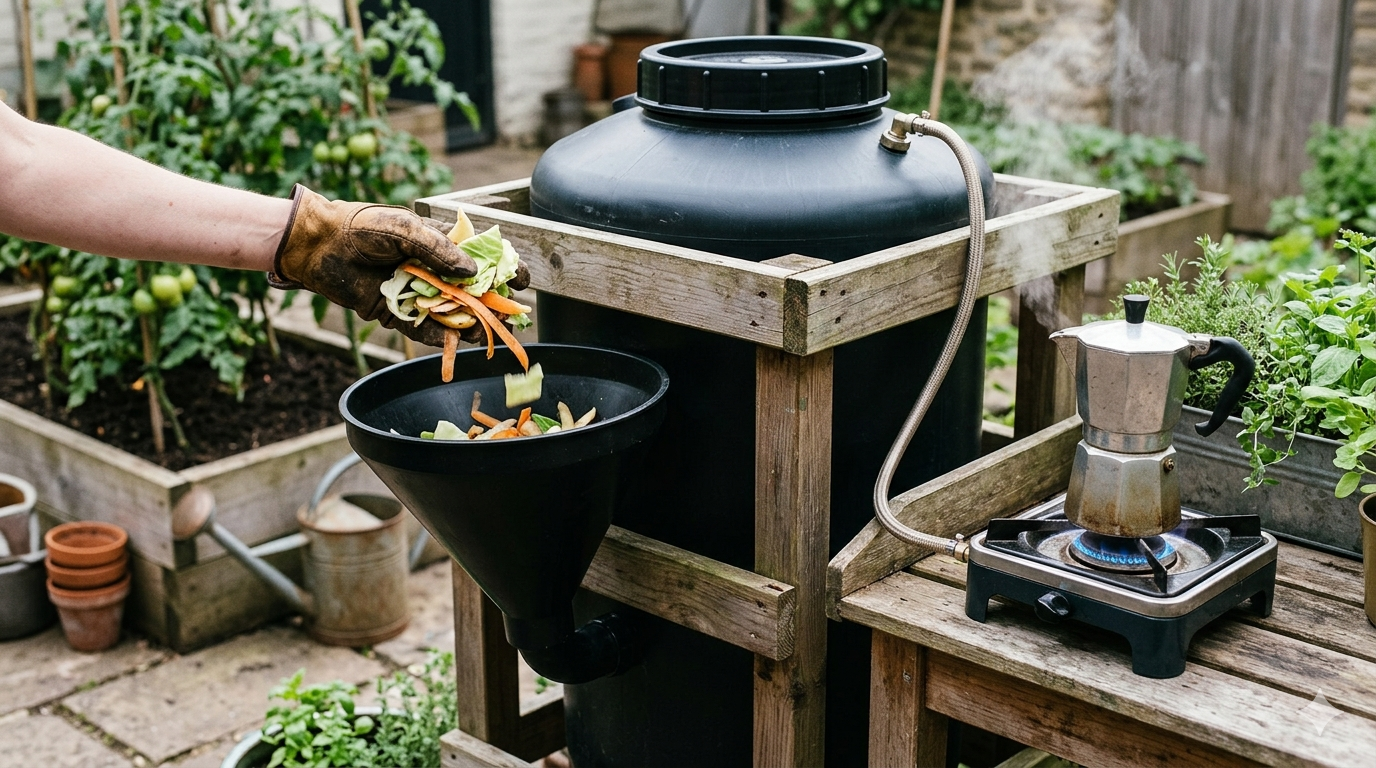
A small-scale anaerobic digestion setup is a great way to turn food scraps and garden clippings into a valuable resource for your home or community. This compact digester is perfect for urban homesteaders, farmers, and anyone looking to reduce their waste and create a sustainable system.
- Food scraps (fruits, vegetables, bread, etc.)
- Garden clippings (grass, leaves, weeds, etc.)
- Water balance system for optimal digestion
- Gas storage tank for capturing biogas
- vegetable and fruit scraps,
- some cooked food residues where the system manufacturer allows them,
- soft green plant material,
- fresh non-woody garden trimmings,
- and water added as required by the specific system.
- how much suitable material is fed into the system,
- temperature,
- digester volume,
- retention time,
- microbial stability,
- gas losses,
- and the equipment used to consume the gas.
- installing and operating the system according to its approved design,
- keeping gas equipment in appropriately ventilated locations,
- preventing uncontrolled gas accumulation,
- protecting gas lines and fittings from damage,
- using components intended for biogas service,
- keeping ignition sources away from unintended gas-release points,
- and checking applicable fire, building and local regulations.
- what entered the digester,
- how completely the material was processed,
- nutrient concentration,
- sanitation and contamination risks,
- the crop being grown,
- and applicable local rules.
- divert a portion of suitable organic waste from disposal,
- produce some usable biogas,
- provide a nutrient-containing digestate stream,
- and demonstrate a practical circular relationship between household waste, energy and the garden.
- a complete household energy replacement,
- a universal solution for all garden waste,
- a maintenance-free appliance,
- or a guaranteed way to eliminate waste or emissions.
Maintaining a consistent feedstock and scale is crucial for an anaerobic digestion setup. If the feedstock is too small or inconsistent, the digester may not function properly, leading to poor gas production and potential system failure. Similarly, maintaining a consistent water balance and safe placement of the digester are essential for optimal performance and safety.
Limitations and Safety Considerations for Small Biogas Systems
While small biogas systems can be a valuable addition to your home or farm, it's essential to understand their limitations and safety considerations. One key factor is climate sensitivity - the system may not perform well in extreme temperatures or humidity levels. Additionally, odor control measures are crucial to prevent unpleasant smells from escaping into the environment.
Another important consideration is pressure management. Biogas systems can generate significant pressure, which must be carefully managed to avoid accidents and ensure safe operation. Regular maintenance is also vital to prevent system failure and minimize downtime. It's also essential to check local rules and regulations regarding biogas systems in your area, as these may vary significantly. Finally, it's important to have realistic expectations about what a small biogas system can achieve - it's not a magic solution for all energy needs, but rather a valuable supplement.
Rising Interest in Waste-to-Energy Gardening Systems
As self-reliant gardeners and sustainability-focused households seek to reduce their environmental footprint, interest is growing in waste-to-energy gardening systems. These innovative solutions convert organic waste into a valuable resource for the garden, promoting resilience and circular gardening practices.
The appeal of waste-to-energy gardening lies in its practical application of reducing waste sent to landfills while generating a natural fertilizer for plants. By harnessing the energy potential of food scraps and yard trimmings, households can create a closed-loop system where waste becomes a valuable resource rather than a problem. This approach not only reduces greenhouse gas emissions but also fosters a deeper connection with nature and our own ecological impact.
What Actually Goes Into a Small Digester?
Not every form of garden waste behaves the same way inside an anaerobic digester.
Soft, readily biodegradable material is generally easier for a small system to process than dry, woody or highly fibrous material.
Potential household-scale feedstocks can include suitable quantities of:
Branches, woody stems and other lignified material decompose much more slowly and should not simply be treated as equivalent to kitchen scraps.
Feedstock restrictions also vary by digester design. Follow the manufacturer's operating guidance and applicable local rules rather than assuming that every organic material belongs in the system.
Biogas Production Is Not the Same as Usable Energy
A digester producing gas does not automatically mean that all of that gas is immediately useful.
Raw biogas is primarily methane and carbon dioxide, but it can also contain moisture and trace contaminants. The exact composition varies with feedstock and operating conditions.
The amount of useful fuel available depends on several factors:
For that reason, a small household digester should be viewed as a supplemental energy system rather than a guaranteed source of continuous household power.
Temperature Matters More Than Many Beginners Expect
Anaerobic digestion is a biological process, so microbial activity changes with temperature.
When conditions become substantially cooler, gas production can slow significantly. This is especially important for small outdoor digesters because they have less thermal mass than large agricultural systems.
Climate therefore affects both system choice and expectations. A design that performs well in a warm climate may produce much less gas during a cold season unless the system is specifically designed for those conditions.
Gas Safety Is Part of the Design
Biogas contains methane, which is flammable. Raw biogas can also contain small amounts of gases that should not be inhaled or allowed to accumulate in enclosed spaces.
A small digester should therefore be treated as fuel-producing equipment, not simply as another compost container.
Basic safety principles include:
Do not improvise pressure vessels, gas-storage components or household gas connections.
Pressure Management Does Not Mean More Pressure Is Better
Biogas systems operate with specific pressure limits. The objective is controlled delivery, not maximum pressure.
Gas storage, regulators, hoses, burners and safety components must be compatible with the system being used.
If gas flow becomes weak or inconsistent, the solution is not to modify the digester or artificially increase pressure without an approved design. Feedstock conditions, temperature, gas production and equipment compatibility should be evaluated first.
Digestate Needs Its Own Reality Check
The liquid or slurry leaving a digester still deserves careful handling.
Calling it "fertilizer" can make it sound as though it is automatically appropriate for every plant and every application. That is too simple.
Its usefulness depends on:
When digestate is appropriate for garden use, it should be managed as a nutrient-containing amendment rather than applied indiscriminately.
What a Small System Can Realistically Do
A compact household digester is most convincing when expectations remain modest.
It can potentially:
It should not be presented as:
The most useful question is therefore not "How much energy can I get?" but "Does the amount and type of organic waste I produce justify a digester that I can operate safely and consistently?"
FAQ
What do small biogas systems use?
Small biogas systems can use suitable biodegradable feedstocks such as many food scraps and some soft, non-woody garden materials. Woody stems, branches and highly lignified material break down much more slowly and are generally poor feedstocks for a simple household digester unless they receive additional processing.
What do small biogas systems produce?
These systems generate biogas, primarily a mixture of methane and carbon dioxide, with composition varying according to feedstock and operating conditions. Where equipment and local rules permit, small systems are most commonly considered for direct cooking applications. Electricity generation or use with other appliances requires appropriate gas conditioning and dedicated conversion equipment.
What limitations matter when using small biogas systems?
When designing and implementing a small biogas system, it's essential to consider factors such as temperature, pH levels, and moisture. Additionally, the size of the system will impact its overall efficiency and effectiveness. Proper maintenance and monitoring are also crucial for optimal performance.
Small biogas systems are one possible tool in a resilient garden, but they work best when feedstock, climate, safety, maintenance and realistic energy expectations are considered together.